
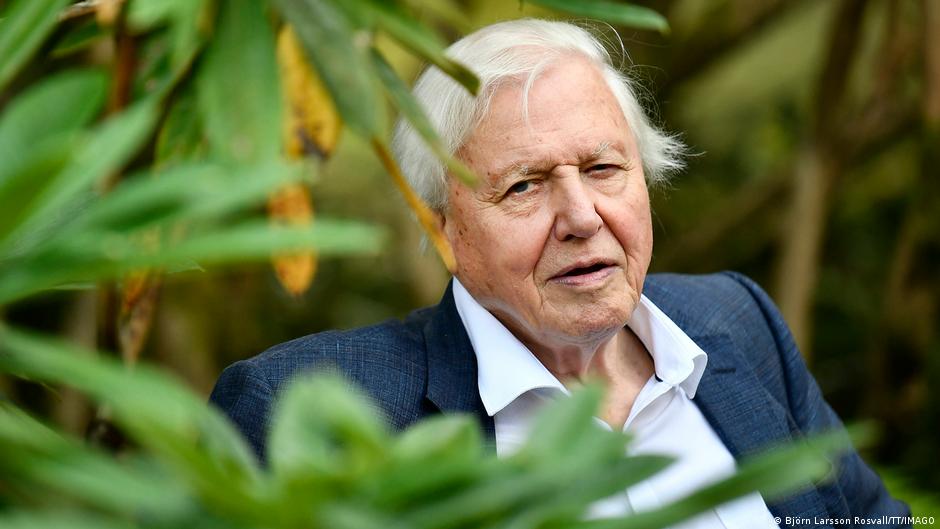
The still-sprightly centenarian has been knighted twice, nominated for the 2022 Nobel Peace Prize, and is perhaps the world's most recognizable nature lover.
He holds the Guinness World Record for "the longest career as a television presenter and naturalist." From his on‑screen debut in "Animal Disguises" in 1953 to the recent Netflix documentary "A Gorilla Story: Told by David Attenborough," his broadcasting life has spanned more than 70 years.
A history of making history He has accumulated a wide range of distinctions over the years — from 32 honorary degrees to two knighthoods — and even set a social media record in 2020 when his new Instagram account drew more than 1 million followers in 4 hours and 44 minutes.
When BBC's "Blue Planet II" premiered in 2017, demand in China was so intense that local media reported temporary internet slowdowns as viewers rushed to stream it.
Attenborough was first knighted by the late Queen Elizabeth II in 1985. In June 2022, he was knighted a second time by then Prince Charles for his nature documentaries and advocacy, becoming a Knight Grand Cross of the Order of St Michael and St George.
In April that same year, he received the United Nations' highest environmental honor, namely the UN Champions of the Earth Lifetime Achievement Award. Together with Pope Francis and the World Health Organization, he was also one of the nominees for the 2022 Nobel Peace Prize .
He is also the only person to have earned the UK's BAFTA awards across every major era of television technology — from black‑and‑white to color, HD, 3D and 4K. In his native UK, he is often referred to as a "national treasure" — a term that doesn't sit well with him.
Early fascination with fossils David Frederick Attenborough was born on May 8, 1926 in England, the second of three boys. His sibling, Richard, was the renowned actor and director who famously played John Hammond in the 1993 film "Jurassic Park" and its 1997 sequel, and directed the Oscar-winning film "Gandhi" in 1982.
His fascination with fossils stems from childhood. In a 2019 interview with German magazine Der Spiegel , he said he considered it a form of "magic" to come across the remains of an ancient creature that "hasn't seen the sunlight for 150 million years." He often rode his bicycle long distances to nearby quarries, hoping to uncover more specimens.
Big teeth and Monty Python After graduating from Cambridge University in 1947 with a degree in Natural Sciences, David Attenborough spent two years of national service in the British navy.
In 1950, he applied to work for BBC ' s radio service, but was asked if he would like to try the broadcaster ' s new trainee program instead.
Over time, he moved into senior roles at the BBC and eventually became controller of BBC Two, where he played a key role in bringing color broadcasting to European audiences. He also approved "Monty Python's Flying Circus" in 1969, the comedy troupe's first ever major production series.
Mother nature's 'semi-whispering' champion However, he eschewed a management career at the BBC, choosing instead to marry his love of nature with broadcasting. He narrated every episode in the long-running "BBC Wildlife on One" (1977-2005).
He was also narrator for other high-profile BBC wildlife documentaries like "The Blue Planet" and "Planet Earth," having a "patented semi-whisper way of narrating," as noted by NPR radio once.
During the filming of "Paradise Birds," a cheeky bird-of-paradise forced several retakes after it repeatedly interrupted the amused presenter with its calls and fancy moves.
Over 40 species of flora and fauna — both living and extinct — have been named after him. This includes a prehistoric marine reptile called the Attenborosaurus, and a Madagascan dragonfly called Attenborough's pintail.
There is one animal that petrifies him though.
"I really, really hate rats. I've handled deadly spiders, snakes and scorpions without batting an eyelid. But if I see a rat I'll be the first to run," he told Entertainment Daily in 2021.
Thus, it comes as no surpise that documentaries have been slated to commemorate his 100 years on Earth, including a live celebratory event at the Royal Albert Hall, featuring the BBC Concert Orchestra and special guests who will honor the naturalist and his illustrious career.
Edited by: Elizabeth Grenier Advertisement