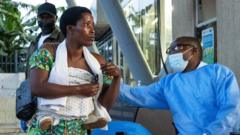
Hundreds of cases are suspected in central Africa but experts fear the actual number may be much higher.
Ebola may be spreading faster than first thought, WHO doctor warns 1 hour ago Sofia Ferreira Santos Reuters The outbreak, which started in DR Congo, has also spread to neighbouring Uganda An Ebola outbreak which has killed at least 131 people in the Democratic Republic of Congo may be spreading faster than originally thought, a World Health Organization (WHO) representative has warned.
Dr Anne Ancia told the BBC that the more the agency investigates, the clearer it becomes that cases have spread to other areas.
Officials said more than 513 cases were suspected in DR Congo as of Tuesday, while one person has died in neighbouring Uganda.
But modelling by the London-based MRC Centre for Global Infectious Disease Analysis released on Monday suggested there had been "substantial" under-detection, and that it could not rule out there had already been more than 1,000 cases.
The study suggested that the current outbreak is "larger than currently ascertained" and that its "true magnitude remains uncertain".
The Red Cross warned that Ebola can escalate quickly if cases are not identified early, communities lack information and health systems are overwhelmed, adding that "we are seeing all those conditions" in the current outbreak.
On Tuesday, DR Congo President Félix Tshisekedi called for "calm" and urged Congolese citizens to remain vigilant, after holding a crisis meeting on Monday evening.
WHO chief Tedros Adhanom Ghebreyesus, who declared the outbreak an international emergency last week, said he was "deeply concerned about the scale and speed of the epidemic".
It is feared the outbreak may have been ongoing for several weeks before it was first detected on 24 April.
There is no vaccine for the strain of Ebola virus fuelling the latest rise in cases, but the WHO is evaluating whether other drugs may provide protection.
World Health Organization/Handout via Reuters WHO is sending tonnes of health supplies to DR Congo, including personal protective equipment (PPE) and medicine Speaking to BBC Newsday, Ancia said DR Congo's Ituri province, the epicentre of the outbreak, was a "very unsecured area with lots of movement of population", making it difficult for the agency to investigate and help control the disease.
She continued: "The more we are investigating this outbreak, the more we realise that it has already disseminated at least a little bit across border and also in other provinces." The outbreak has spread to the province of South Kivu, where the population has been affected by a humanitarian crisis for many years, she added.
There has also been a case in eastern DR Congo's biggest city, Goma, which has a population of around 850,000 people and under the control of Rwandan-backed rebels.
High levels of insecurity in several provinces mean people move around often, increasing the risk and spread of the virus, she said.
Several African countries are taking precautions by tightening border screenings and preparing health facilities. Neighbouring Rwanda has also closed its borders with DR Congo. Uganda has told people to avoid hugging and shaking hands.
An American citizen, believed to be missionary group doctor Peter Stafford , is being evacuated from DR Congo after developing symptoms over the weekend.
Germany's health ministry told the BBC a US citizen was being taken to the country for treatment.
The US Centers for Disease Control and Prevention (CDC) said it was working to evacuate at least six other Americans who were exposed.
WHO and other agencies are working with governments and communities to try to stop the spread of the virus, urging residents to follow preventative measures and report to the nearest health facility if they experience any symptoms.
What is Ebola and how does it spread?
Ebola is caused by a virus and initially causes symptoms similar to the flu, with fever, headache and tiredness.
As the disease progresses, vomiting and diarrhoea develop and it can lead to organ failure. Some, but not all, patients develop internal and external bleeding.
The virus spreads from one person to another by contact with infected bodily fluids such as blood or vomit.
The Bundibugyo strain fuelling this rise in cases is rare, and has previously only caused two outbreaks, when it killed about a third of those infected.
Between 2014 and 2016, more than 28,600 people were infected by Ebola in West Africa, the largest outbreak of the virus since its discovery in 1976.
It was caused by the Zaire strain, for which there is an approved vaccine.
The disease spread to a number of countries in West Africa and beyond, including Guinea, Sierra Leone, the US, UK and Italy, killing 11,325 people.
What is Ebola and why is stopping this outbreak so difficult?
American who contracted Ebola in DR Congo evacuated for treatment At least 131 dead in Ebola outbreak in DR Congo, official says How worrying is the Ebola outbreak in DR Congo?
Uganda Democratic Republic of Congo World Health Organization (WHO) Africa Health Ebola virus