
Concerns raised that cases were caused by a new strain of the virus as African health officials race to coordinate and contain the infectionAn outbreak of Ebola has killed 65 people in the Democratic Republic of the Congo, according to African health officials.There have been 246 suspected cases of the deadly haemorrhagic fever reported so far in Ituri province, which shares borders with Uganda and South Sudan. <a href="https://www.theguardian.com/global-development/2026/may
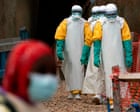
Health workers in protective clothing at an Ebola treatment centre in Beni in eastern DRC during an outbreak of the disease in 2019.
Photograph: Jérôme Delay/AP Photo View image in fullscreen Health workers in protective clothing at an Ebola treatment centre in Beni in eastern DRC during an outbreak of the disease in 2019.
Photograph: Jérôme Delay/AP Photo Ebola outbreak kills 65 people in eastern Democratic Republic of the Congo Concerns raised that cases were caused by a new strain of the virus as African health officials race to coordinate and contain the infection An outbreak of Ebola has killed 65 people in the Democratic Republic of the Congo , according to African health officials.
There have been 246 suspected cases of the deadly haemorrhagic fever reported so far in Ituri province, which shares borders with Uganda and South Sudan.
Officials at the Africa Centres for Disease Control and Prevention (Africa CDC) said they were concerned about the risk of further spread. The area is home to mining towns where people are constantly coming and going, making infectious disease control challenging.
Ebola is a severe illness with a high fatality rate that spreads through direct contact with body fluids such as the blood or vomit of infected people, or dead bodies, such as during funeral preparations.
The DRC’s national research laboratory has detected the Ebola virus in 13 of 20 samples tested, Africa CDC said on Friday.
The DRC has had 16 outbreaks of Ebola since the virus was identified there in 1976.
Typically they have had the Zaire strain of Ebola, for which vaccines are available. However, Africa CDC said early testing suggested the current outbreak was a different type, with fuller genetic sequencing results due within 24 hours.
The health watchdog said it was convening an urgent meeting on Friday with authorities from the DRC, Uganda and South Sudan as well as the World Health Organization and pharmaceutical companies.
“Africa CDC stands in solidarity with the government and people of the Democratic Republic of the Congo as they respond to this outbreak,” said Dr Jean Kaseya, director general of Africa CDC. “Given the high population movement between affected areas and neighbouring countries, rapid regional coordination is essential.” Ten years ago Ebola tore through Sierra Leone. Can a vaccine drive stop history repeating itself?
Read more Cases have been reported mainly in Mongwalu and Rwampara health zones, with suspected cases also reported in neighbouring Bunia.
Dr Michael Head, senior research fellow in global health at the University of Southampton in the UK, said: “The Democratic Republic of the Congo often sees fatalities from Ebola. There is likely a perfect storm of factors that cause these regular outbreaks. Close human contact with animal reservoirs, most likely bats but possibly also primates, is one factor. Other concerns include the movement of people between rural and urban environments, the tropical climate, and the high rainforest coverage.” During the 2014-16 outbreak in west Africa there were an estimated 28,000 cases and 11,000 deaths.
Explore more on these topics Global development Ebola Infectious diseases Democratic Republic of the Congo Africa Global health news Share Reuse this content