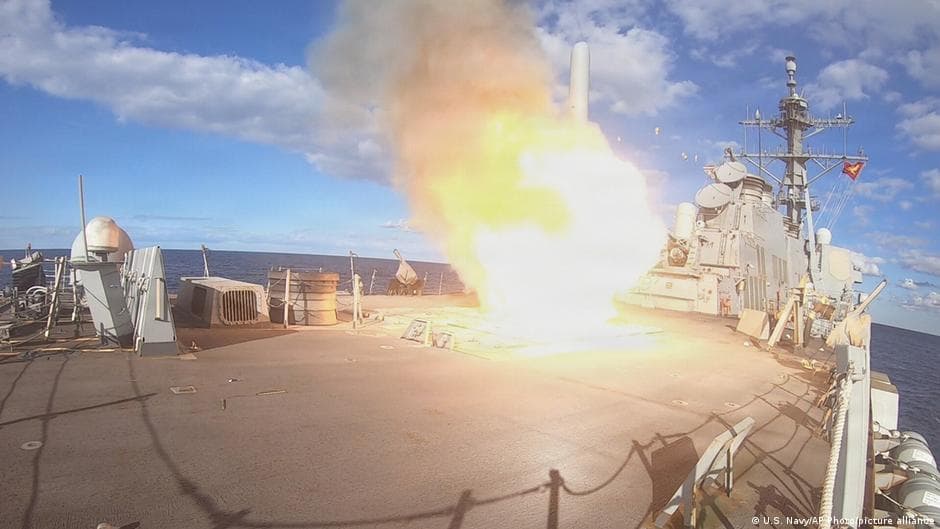
The US has announced that it will not be deploying Tomahawk cruise missiles in Germany. Now the German government is looking for alternatives. Could drones be part of the solution?
The deployment of the Tomahawks had been decided in 2024 by former German Chancellor Olaf Scholz and US President Joe Biden.
Deployment was scheduled to start this year and serve as a stopgap measure until comparable European weapons were developed. But that plan has now been scrapped. US President Donald Trump , who is not on good terms with German Chancellor Friedrich Merz since he criticized the war in Iran, pulled the plug on his predecessor's plan — and also announced the withdrawal of at least 5,000 US troops from Germany.
What this decision by the White House means for German Defense Minister Boris Pistorius is that a gap has now opened in Germany's national defense. Not only had the US planned to station Tomahawk cruise missiles in Germany, but also SM-6 anti-aircraft missiles and hypersonic weapons capable of traveling great distances at multiple times the speed of sound.
With this arsenal of weapons, the US military would have been equipped to carry out the kind of long-range precision strikes that Germany is so far unable to conduct with its own systems. Their deployment was meant to counterbalance Russia's military arsenal.
Russia has stationed "Iskander" missiles — which can be armed with nuclear warheads — in the Kaliningrad exclave, located on the Baltic Sea between Poland and Lithuania. From there, they could reach Berlin and other parts of Europe. In addition, Russia has medium-range "Oreshnik" missiles in Belarus, which can also be fitted with nuclear warheads.
Defense Minister Boris Pistorius is now looking for ways to close this gap quickly. And the key word here is "quickly." Germany's new military strategy sets out to speedily outfit the German Armed Forces, the Bundeswehr , to be able to carry out "deep precision strikes" from great distances — that is, precision strikes deep inside enemy territory. "Potential targets may include command posts, airfields, logistical hubs and weapons factories," reads the website of the German Ministry of Defense.
Security experts say that is too late. Military expert and political consultant Nico Lange wrote on Platform X: "Closing the deterrence gap for good so that we are no longer vulnerable to blackmail by Russian missiles — that can now only be achieved by fast-tracking a program in Germany to produce our own ground-based cruise missiles, independent of the US." War in Iran Decimates US Army Stockpiles However, there is still no decision about locating production in Germany. This is where the defense contractor Rheinmetall could play a role. The Department of Defense is looking into buying expensive Tomahawks from the US. However, the missiles are also in great demand by the US military at the moment: they've already fired thousands of missiles in its war with Iran, including Tomahawk cruise missiles. It's unlikely they'll have enough left to send abroad.
US troop cuts 'not a surprise': German vice defense chief To view this video please enable JavaScript, and consider upgrading to a web browser that supports HTML5 video But Pistorius is determined to exhaust every option. During a trip to Washington at the end of May, he plans to discuss Germany's interest in purchasing the missiles. "We submitted an official request to the Americans a year and a half ago to import — that is, to purchase — Tomahawk missiles. We are still awaiting a response," said the defense minister on German public television channel ZDF . "But to be honest, given the current state of the world, I don't have much hope in that regard." Germany has also expressed interest in purchasing the "Typhoon" missile launch system from US defense giant Lockheed Martin. The Pentagon has not yet responded to this request either.
Another way to at least partially close the gap in capabilities could be long-range drones. While they are less effective than Tomahawk cruise missiles, for example, they are significantly cheaper to manufacture.
Germany plans to produce these weapons in collaboration with Ukraine. During his visit to Kyiv on Monday, May 11, 2026, Pistorius emphasized that the focus is on jointly developing "state-of-the-art unmanned systems across all ranges, particularly in the area of deep strike." Drone models with a range of up to 1,500 kilometers are what he has in mind.
Ukraine has been defending itself against Russia's invasion since February 2022 and has become one of the world's leaders in drone warfare. It would be an interesting development if the two countries do collaborate on long-range weapons systems. After all, Germany had previously refused to include Taurus cruise missiles in its military aid package to Ukraine, yet now the two countries plan to cooperate on producing weapons capable of striking targets at even greater distances.
This article was translated from German.
US troop withdrawal: A turning point for Europe?
To view this video please enable JavaScript, and consider upgrading to a web browser that supports HTML5 video Advertisement