
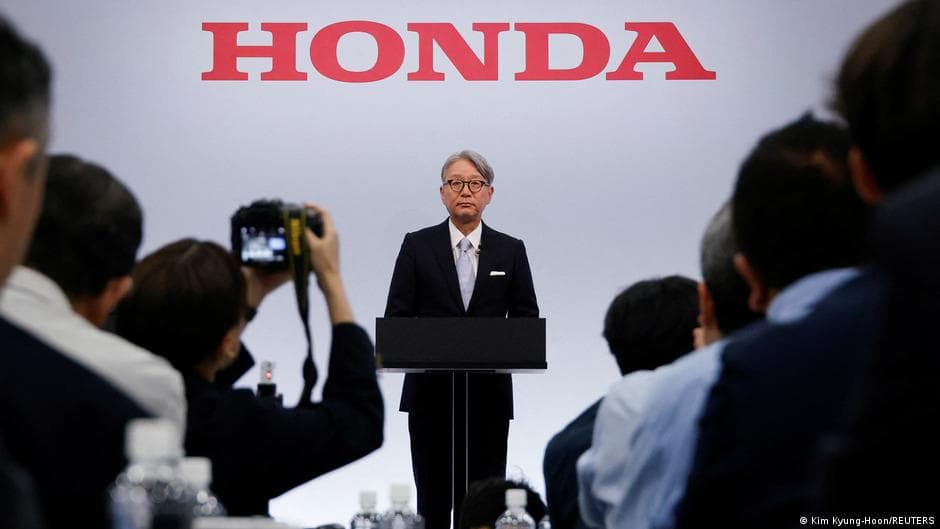
The Japanese carmaker pursued an aggressive switch towards electric vehicles that it's now trying to walk back. Despite posting its first loss on record, its share price spiked on more buoyant predictions for 2026.
The company has embarked on a major overhaul of its electic vehicle (EV) strategy, particularly in its core market in the US, after previously betting on more rapid electrification of the industry.
Honda had already warned of a sizeable financial hit as a result of this shift in March, meaning that investors were largely unperturbed by Thursday's financial data. Indeed, Honda's stock rose sharply as the company also predicted a return to profitability in 2026.
What were Honda's losses and sales figures?
The company reported an operating loss of 413.4 billion yen (roughly €2.23 billion or $2.6 billion) amid huge write-downs in its EV operations.
Honda also posted a slightly larger net loss, at 423.9 billion yen.
The company sold 3.4 million four-wheeled vehicles around the world in the fiscal year through March, down from 3.7 million the previous year.
Honda's older and even more successful motorbike business helped pare the losses, as it sold 22.1 million motorcycles, versus 20 million in the previous fiscal year. Honda dominates several markets, including India, in the sale of new motorbikes, thanks in very large part to the budget Super Cub models that have led global sales figures ever since the 1950s.
The company forecast a return to profit for the fiscal year through March 2027, and at one point early on Thursday its share price had risen by as much as 8% in response. It dipped into less pronounced positive territory as trading continued in Asia.
What factors did the company cite?
Honda said on Thursday that a "government policy shift" under US President Donald Trump's administration, affecting sales and strategy in its largest market by far, played a large role in the losses.
The US scrapped tax incentives for EV buyers as part of the so-called "Big Beautiful Bill" of September 2025.
Honda also noted a "decline in competitiveness" of Honda products in China and other Asian countries, as Western manufacturers — including Germany's car giants — struggle to keep pace with rapidly improving Chinese competition.
The war in the Middle East, and the subsequent strain on the supply and price of oil and energy, as well as some other exports, not to mention its impact on the general economy, also poses a threat to the industry.
Other Japanese manufacturers have also been struggling in recent months. Toyota last week forecast a 22% drop in net income this fiscal year.
Nissan on Wednesday posted losses of $3.4 billion. It is seen as the most hard hit of the major Japanese marques, as it is also closing factories and cutting thousands of jobs.
Suzuki is an outlier, posting an 8% increase in revenue in 2025 on Thursday thanks to its focus on growth markets India and Latin America.
"EV demand has declined considerably, due to the rollback of environmental regulations in the U.S. and other factors," the company said in a statement.
The company last month abruptly canceled the planned development of two electric cars with electronics giant Sony.
Have Sony and Honda made the car of the future?
To view this video please enable JavaScript, and consider upgrading to a web browser that supports HTML5 video Chief Executive Officer Toshihiro Mibe said the company's new growth strategy would continue to pursue carbon neutrality. However, he said the company still needed to work on hybrids and regular internal combustion engine models as well, not just EVs.
Asked if he would resign in response to the loss, which can be common among Japanese executives giving bad news, Mibe said he wanted to take work on the revival plan first.
"We will continue our research to develop future technologies including electric vehicle batteries,” he said. “We will get back on a growth track." Edited by: Roshni Majumdar Advertisement


