From a small town in Spain to sold-out global arenas, Spanish singer Rosalia has built her career with precision rather than luck. How did she do it?
In reality, her rise reflects a careful, sustained progression of a young woman determined to make it big.
Rosalia Vila Tobella grew up in the Spanish town of Sant Esteve Sesrovires, about a 40-minute drive from Barcelona.
Music was part of her life from early on. She learned to dance at local venues and sang and played guitar when she was still a young girl. One of her former teachers remembered her as confident and determined — and how she insisted that even as a teenager, she was destined to be a pop star .
Roots in flamenco Rosalia's formal training centered on flamenco , which formed the backbone of her music. Deeply inspired by the groundbreaking flamenco singer Camaron de la Isla, who revolutionized the genre by blending pop and jazz influences, she started her formal flamenco education at the music school Taller de Musics in Barcelona , where she immersed herself heart and soul into the expressive genre from Southern Spain.
The school's founder, Lluis Cabrera, described her in a DW interview as being "a cut above the other students," pointing to her "insatiable appetite for learning and constant curiosity." Flamenco is far from an easy genre to master; it requires control and raw emotional intensity. And that's in part what the singer's expressive voice has become known for.
But Rosalia didn't stop there. Instead of staying within traditional boundaries, she used her flamenco training to steer the tradition-steeped genre in a more contemporary direction — especially in her first two albums.
Her later work blended those influences with pop, electronic and reggaeton, opening her music to a much broader audience and marking the beginning of her international breakthrough.
"On the 'Motomami' album, she plays with those red looks, with that gasoline, with the motorcycle, with the skin, with the leather, with the artist's sexuality, with that desire to express herself," points out Almenar. Musically, too the 2002 album "Motomami" was unafraid to experiment and was hailed by music magazine Rolling Stone for being "brazen," and "uncompromising." The album showcases her as a radical pop rule-breaker as the album shifts from ambient music to bachata to reggaeton.
Earlier this year, the singer received the BRIT Award for International Artist of the Year and was also named 2026 Woman of the Year at the Billboard Latin Women in Music gala — a testament to her current fame.
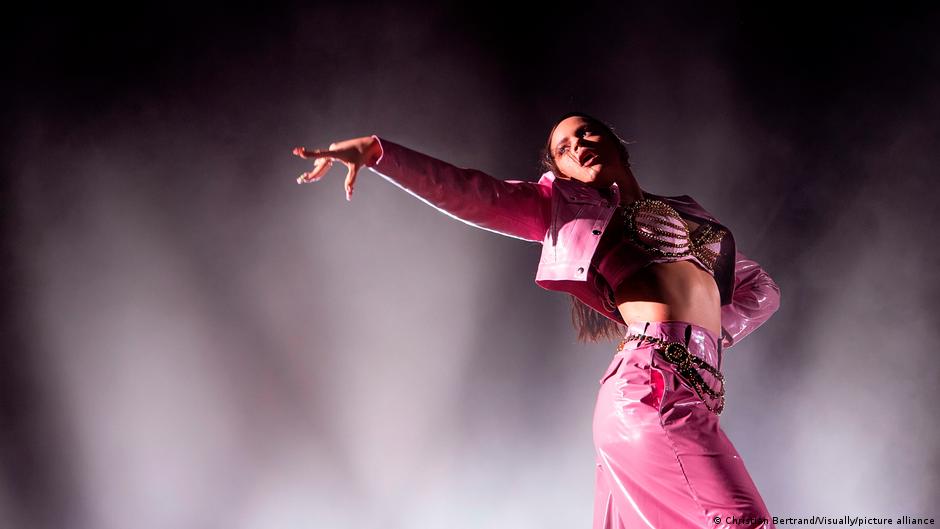
"It was a masterpiece of art — from the scenography to the choreography to her incredible voice," Berlin-based Madrid-born architect Itziar Leon Soriano. who attended the Berlin show at Uber Arena on May 1, told DW. "It was very well thought out and curated." All four of her LUX Tour concerts at Barcelona's Palau Sant Jordi sold out in advance, pointing to the star's special appeal in Spain and Catalonia. Her music can be seen in a sense as uniting a deeply politically divided Spain: Rosalia has largely remained apolitical, while also raising the visibility of the Catalan language, using it in some songs, which is rare for an artist of her stature.
Rather than an overnight sensation, Rosalia's career suggests that of an artist who has blended tradition and experimentation into a recipe for how global pop can evolve.
Edited by: Elizabeth Grenier Advertisement