
Peter Magyar hopes to mend relations with Poland during his first state visit to Warsaw. What lessons could he learn from Poland's Prime Minister Donald Tusk?
On Tuesday, ten days after his inauguration on May 9, 2026, Magyar's first trip abroad took him to Poland , "our natural allies," as Hungary's new leader called to the Poles last year.
Historically, Poland and Hungary have mostly had close ties. Under the Polish right-wing nationalist governments of the Law and Justice Party ( PiS , 2015–2023) and the Hungarian Civic Alliance (Fidesz, 2010–2026), Warsaw and Budapest formed an illiberal, EU-critical alliance for years. However, this rapport was increasingly put under pressure, particularly since the start of the war in Ukraine. The pro-Russian policies of Hungary's long-time Prime Minister Viktor Orban were never supported by the Polish right-wing party.
In late 2023, when Tusk's pro-European center-left government took the helm in Poland, relations hit rock bottom. "Everything is clear between us, we have different views on every matter, on every issue," Tusk told Polish reporters in October 2025. He added that Orban opposed democratic norms and judicial transparency.
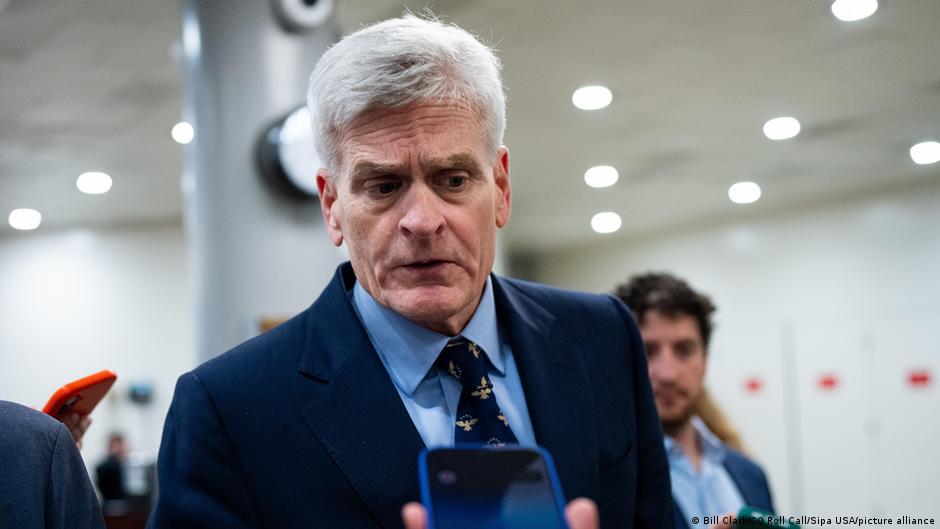
Polish Prime Minister Donald Tusk has shifted to a more central right position since he took office in 2023.
Magyar's visit to Poland is a "symbolic" explains Marcin Bosacki, State Secretary at the Polish Ministry of Foreign Affairs. "It is important to us that the new Hungarian government is demonstrating, through such a powerful symbolic gesture, that friendship with Poland is important." Rebuilding trust Expectations for the meeting are high on both sides, sociologist Edit Zgut-Przybylska, a researcher at the Polish Academy of Sciences in Warsaw and at the CEU Democracy Institute in Budapest, told DW. "The trust that was destroyed by the pro-Russian and extremely anti-European policies of the former Hungarian government must be restored," she said.
Magyar and seven ministers will visit Krakow, Warsaw , and Gdansk during the trip, where the Hungarian prime minister is scheduled to meet with Prime Minister Donald Tusk, President Karol Nawrocki, and former Polish President Lech Walesa.
Magyar's trip could also support his plan to steer Hungary back onto a more EU-friendly course after 16 years of Orban's rule. In the process, he also seeks to recover frozen EU funds. Tusk's advice could be useful: the Polish prime minister had a long career in European institutions and also secured the release of €137 billion ($159 billion) in EU funding following his election victory.
Magyar and Tusk are also likely to quickly find common ground on issues such as migration restrictions and climate policy: Since taking office 2.5 years ago, the once-liberal Polish prime minister has shifted many of his views to the right.
Reviving the V4?
Magyar has repeatedly called for the revival of the " Visegrad Group " consisting of Poland, Hungary, the Czech Republic , and Slovakia . Also known as the " V4 ", this group began in the early 1990s. In recent years it was virtually paralyzed amid disputes between Orban and Tusk. In early May, Slovak Prime Minister Robert Fico posted a joint photo with Czech Prime Minister Andrej Babis and Tusk. The caption said: "Three Musketeers await the fourth and the revival of the V4." But getting a new lease of life for the international grouping will take more than a selfie, warned Martin Vokalek, director of the Brussels-based think tank Europeum. In an interview with DW, Vokalek said he initially expected pragmatic cooperation around specific issues. Meanwhile, Poland has its sights set on other international ties, he said. "Poland now sees itself more as a regional power and wants to move significantly closer to Germany and France." Although Poland, with its strong economy, acts as a regional leader in Central and Eastern Europe, Magyar will not be on a lesser footing during talks in Warsaw. After all, he has achieved what Tusk can only dream of: a majority that allows him to govern unimpeded. The Polish prime minister, on the other hand, relies on a awkward coalition. The Christian Democratic and conservative partners continue to block his campaign promises, for example, liberalizing abortion laws or same-sex partnerships.
However, Magyar will not be able to bring the gift that his Polish partners would love to receive: They would like a return of the wanted Polish politicians, Zbigniew Ziobro and Marcin Romanowski, but they have already left Hungary — presumably aided by the old regime before the new prime minister was sworn in.
Hungary enters post‑Orban era as new PM takes office To view this video please enable JavaScript, and consider upgrading to a web browser that supports HTML5 video This article was originally published in German.