India's state-run fuel retailers hiked fuel prices for the second time in a week with no end in sight for the Iran conflict. Meanwhile, PM Narendra Modi will attend the India-Nordic Summit in Norway. DW has more.
The panel involved in the February London-Bengaluru incident was later deemed "serviceable" by Boeing and India's Directorate General of Civil Aviation (DGCA), Reuters reported citing internal emails.
The DGCA now wants to examine the switch's locking mechanism, including whether external pressure applied at a particular angle could move it when locked, the report said citing an Indian government official explaining the reasoning behind the Seattle visit.
The Indian government "wants to be thorough," said the official, who requested anonymity because the matter is sensitive.
The issue has drawn renewed attention because similar fuel switches came under scrutiny during the investigation into last year's deadly Air India crash in Gujarat that killed at least 260 people.
The US Federal Aviation Administration had said the crash did not sppear to have been caused by a mechanical issue and that a recorded dialogue between the flight's two pilots showed that the captain cut the flow of fuel to the engines, Reuters had reported last year.
India's pilots union and the captain's father, who had called for an independent investigation, denounced the implication that the crash was deliberate.
Under international rules, a final report into the crash from India's Aircraft Accident Investigation Bureau is due next month.
Moreover, the court granted authorities the permission to legally kill dogs which had turned rabid or "aggressive," citing the "menace of dog bites" in public places.
Concerned authorities may take legally permissible measures "including euthanasia in cases involving rabid, incurably ill, or demonstrably dangerous/aggressive dogs" to address the "threat posed to human life," the court said in its ruling.
The top court said this while dismissing a bunch of applications seeking modifications to the directions issued by the court in November of last year.
"This court cannot remain oblivious to the deeply disturbing ground realities emerging from various parts of the country where young children and elderly persons have been attacked, ordinary citizens have been left vulnerable in public places, and even international travelers have fallen to such incidents," it said, according to legal news outlet Live Law.
No complaints to be registered against dog catchers The ruling also directed police authorities not to take down complaints against civic authorities for carrying out their duties as directed by the court.
Animal rights advocates fear that this direction would not allow investigations into disputed cases of animal cruelty.
The government-run program calls for a catch-neuter-vaccinate-return policy to control the population of stray dogs. However, the court's ruling does not allow for dogs to be returned to where they were picked up from after being vaccinated and sterilized.
The court blamed a poor implementation of the ABC Rules for India's stray dog problem.
"Prolonged inaction and absence of institutional commitment to effective implementation of ABC framework have contributed significantly to the persistence as well as aggravation of the problem, which has now assumed dimensions warranting urgent and systemic intervention," the court observed.
Despite the overlapping instructions, the top court directed authorities to implement the ABC rules in at least one center in one district, and asked the High Courts to monitor compliance.
In November 2025, the court directed authorities to remove stray dogs from public places such as schools, hospitals, bus stands, railway stations and sports complexes after taking cognisance of the rising cases of dog bites across India and its capital city. That order also banned the feeding of stray dogs except in designated feeding spots.
Delhi's stray dog dilemma: Rabies, reform and coexistence To view this video please enable JavaScript, and consider upgrading to a web browser that supports HTML5 video https://p.dw.com/p/5Dy1I Skip next section Norwegian journalist faces harassment after asking Modi to take press questions 05/19/2026 May 19, 2026 Norwegian journalist faces harassment after asking Modi to take press questions "I never thought I would have to write this, but I am not a foreign spy of any sort, sent out by any foreign government." Those are the words of Norway-based journalist Helle Lyng, the woman who raised questions over the lack of interaction between Indian Prime Minister Narendra Modi and the press during a joint statement in Norway.
"Prime Minister of India, Narendra Modi, would not take my question, I was not expecting him to. Norway has the number one spot on the World Press Freedom Index, India is at 157th, competing with Palestine, Emirates and Cuba. It is our job to question the powers we cooperate with," she had said on Monday.
"In Norway, when foreign leaders visit, the press usually will get to ask questions. Not many, but a few. That was not the case today with Modi, and will not be tomorrow either," she said in a follow-up post.
The Indian Embassy soon made her aware of a ministry press briefing that evening. At that event, visibly agitated Indian diplomat Sibi George slammed journalists for their lack of understanding and reliance on "ignorant NGOs," while defending India's human rights record.
However, since the first social media post, Lyng faced growing online accusations of "staging" a "hit job" against India. Social media trolls accused her of being a "dishonest journalist" at best, a "foreign spy" at worst.
"Journalism is sometimes confrontational. We seek answers," she said in a recent post, adding that it was her "job" and "duty" to do so.
Press freedom in India has become a recurring flashpoint during PM Modi's tour of Europe.
In the Netherlands, Dutch Prime Minister Rob Jetten told reporters that his government and other EU member states had concerns about developments in India under the rule of Modi's Hindu nationalist Bharatiya Janata Party.
A journalist from the Dutch newspaper De Volkskrant also questioned why Modi was not available for questions.
India's Foreign Secretary (West), Sibi George, had a similar response even then. He claimed the ministry faced these kinds of questions because of "lack of understanding" of journalists.
Since taking office in 2014, Modi has participated in a press conference only once in 2019. On that occasion, too, he did not take any questions himself but directed them towards his Home Minister Amit Shah.
The prime ministers of Norway, Denmark, Finland, Iceland, and Sweden will join Modi. The last summit of this kind was held in Copenhagen in May 2022. This will be Prime Minister Modi's first visit to Norway, marking the first visit by an Indian prime minister in 43 years.
India's bilateral trade with the Nordic countries has reached $19 billion (€16.3 billion). Over 700 Nordic companies operate in India. And around 150 Indian companies have a presence in Nordic region.
The summit will "impart a more strategic dimension to our relationship with the Nordics in tech and innovation," India's foreign ministry said in a briefing ahead of Modi's five-nation tour which began on May 15.
The Indian premier has already visited the UAE , the Netherlands, Sweden, Norway and is expected in Italy on Tuesday after the summit concludes.
"From clean energy to climate resilience, from the blue economy to green shipping, in every sector, India's scale, speed and talent will combine with Norway's technology and capital, and our companies will develop global solutions," Modi said on the first day of a two-day visit to the Norwegian capital.
Norway, Europe's largest oil and gas producer excluding Russia, derives almost all of its electricity from renewable sources, primarily hydroelectric facilities.
The new partnership is "beneficial for the entire world", Modi said in a statement to the press.
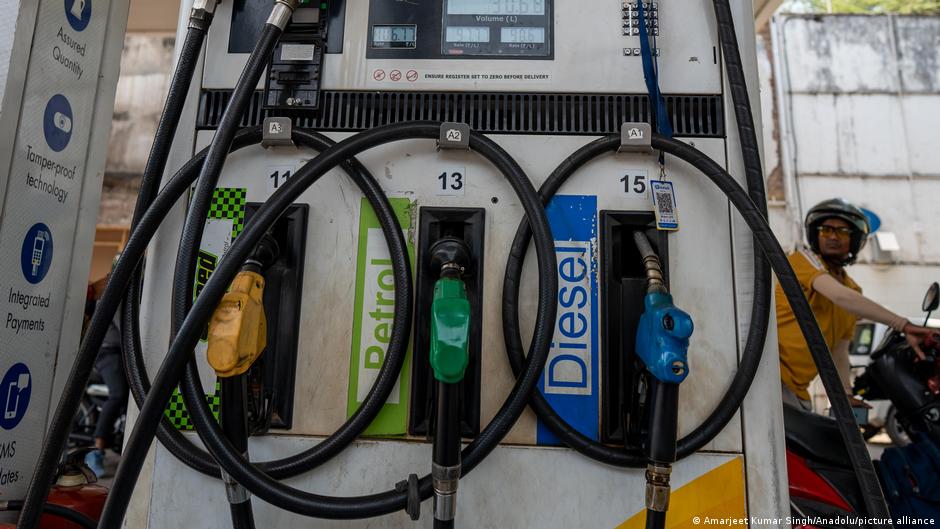
Oil retailers broke a four-year freeze in fuel prices last week, due to global oil shock from the US-Israel war with Iran .
In New Delhi, petrol prices stood at Rs 98.64 (€0,88, $1,03) per liter while diesel prices rose to Rs 91.58 per liter, news agency Press Trust of India reported.
Fuel prices in India differ from city to city due to state-level taxes, transportation costs and dealer commissions.
On May 15, Indian fuel retailers had hiked petrol and diesel prices by Rs 3 per liter , for the first time in four years.
Gas prices have also been hiked twice over the last week, sparking worries among public transport operators.
These hikes come soon after India completed its Assembly Elections for the year, extending Prime Minister Narendra Modi-led Bharatiya Janata Party's influence after it won three of five states.
India's opposition has accused the government of delaying fuel hikes to gain voters' favor for the elections.
Indian voters are significantly sensitive to fuel price hikes, at times swaying their vote at the ballot.
Last week's increase covered just a fifth of the desired hike required to level rates with cost. Experts then had signalled that more hikes were in store.
On Monday, Sujata Sharma, Joint Secretary in the Ministry of Petroleum and Natural Gas, had stated that the May 15 hike had cut losses by a fourth and that oil companies were still incurring about Rs 750 crore (€66.85 million, $77.9 million) a day loss.
How Iran war energy crisis strengthens case for renewables To view this video please enable JavaScript, and consider upgrading to a web browser that supports HTML5 video https://p.dw.com/p/5DxKb Skip next section Welcome to our coverage 05/19/2026 May 19, 2026 Welcome to our coverage Dmytro Hubenko Editor Good morning, and welcome to DW's India news blog!
This is Mahima Kapoor from the New Delhi bureau, and I will be your guide through the day’s biggest headlines from India.
People across northern and central India braced for extreme heat as the national weather agency warned of "heatwave to severe heatwave conditions" for the entire week. In Delhi, the mercury is expected to hit 45 degrees Celcius today and residents have been advised to stay hydrated, avoid long exposures to the sun and watch out for heat-related illnesses.
And there is little relief on the economic front either, with fuel prices climbing for a second time in a week. Economists and the country's central bank had warned Indians that hikes were inevitable with no end to the Middle East conflict in sight.
Meanwhile, Prime Minister Narendra Modi is on the fourth leg of his five-nation tour to shore up trade, investment, energy and defense agreements for India amid the changing geopolitical landscape.
He is set to attend the third India-Nordic Summit in Norway today and then fly to Italy — the last of the five nations.
We have all of this and much more coming up. Stay tuned.