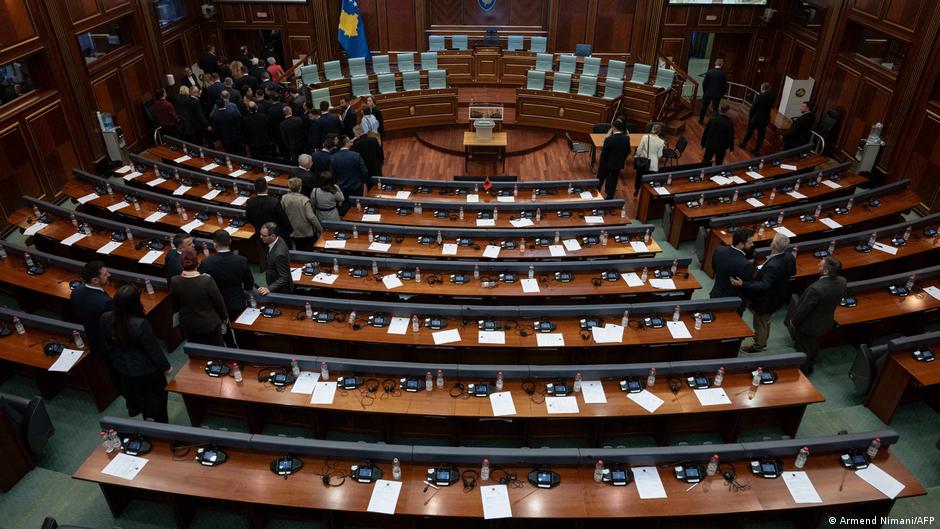
Kosovo will soon hold its third parliamentary election in a year and a half. Prime Minister Albin Kurti was able to form a government in February, but now there's political deadlock over who should be elected president.
If a new president had not been elected by April 28, parliament had to be dissolved — and that is exactly what happened. Kosovo will now hold another election in June — the third since February 2026.
The latest crisis was triggered because Albin Kurti , the prime minister and head of the Self-Determination (Vetevendosje) movement, was unable to reach a consensus with opposition parties on a joint candidate for the presidency. Vetevendosje won around 5% of the vote in the last election at the end of December 2025.
Now that the parliament has been dissolved, Kurti's government, which was only formed in February, is in office only on a caretaker basis.
Kurti and Osmani split Vjosa Osmani, who served as Kosovo's president for five years between 2021 and early April 2026, had originally intended to run for a second term. But she did not have the support of her prime minister, even though the two of them had been considered the hope for Kosovo's new political leadership five years ago.
Kurti did not explicitly state that he would not support Osmani for another term. He simply justified his lack of backing by saying that he could not secure more than 66 votes for her election. That is the number of seats his party has access to, with the governing parties and non-Serbian minorities in parliament. But it takes at least 80 votes out of a total of 120 to elect the president.
Osmani openly stated her intention to seek re-election when her term came to an end on April 4. She told local media outlets that at the time she had "Kurti's support" and that he had promised her he would support her.
"You are the best president of the 21st century," she said he had told her. But later the situation changed: "I then received a new assessment from Kurti that the Vetevendosje parliamentary group and he personally would no longer support me." In an extraordinary session on April 28, Kurti nominated a candidate from civil society, the doctor and human rights activist Feride Rushiti. But opposition parties boycotted the vote.
"In the international arena, the inconsistent political positions of both sides often led to confusion," he said. "The president frequently acted as a sort of shield or damage-control figure. She often took the lead in foreign policy without conducting proper consultations." Ehat Miftaraj, a political analyst at the Kosovo Law Institute (IKD), told DW that Kurti was perceived as being a "less predictable actor" than Osmani, who was seen to be more cooperative toward international partners.
"While the frequent elections show that Kosovo is a functioning democracy," Miftaraj said, "they also show that the country has restricted capabilities of advancing its strategic interests." "As a result, Kosovo's position in the dialogue [with Serbia] is weak and focus on rule of law and on [EU] integration processes has waned. Kosovo is devoting more energy to managing internal crises than to advancing its agenda for European integration," said Miftaraj. "With the European Union's new strategy related to the Growth Plan, Kosovo, which continues to lag in the region, will most likely lose hundreds of millions of euros in financial support." This article was translated from German.
Advertisement