
Army supported by Russian mercenaries launches airstrikes after offensive by coalition of Islamist extremists and Tuareg separatistsMali’s armed forces, supported by Russian mercenaries, have launched airstrikes targeting a rebel alliance of Islamist extremists and Tuareg separatists as the ruling junta struggles to maintain its hold on power in the unstable west African country.Earlier this week warplanes targeted the key northern town of Kidal, <a href="https://www.theguardian
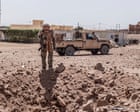
A fighter from the Azawad Liberation Front (FLA), a rebel group, inspects a crater after an airstrike on Kidal by the Malian armed forces.
Photograph: AFP/Getty Images View image in fullscreen A fighter from the Azawad Liberation Front (FLA), a rebel group, inspects a crater after an airstrike on Kidal by the Malian armed forces.
Photograph: AFP/Getty Images Mali’s forces target rebel alliance in junta’s fight to keep power Army supported by Russian mercenaries launches airstrikes after offensive by coalition of Islamist extremists and Tuareg separatists Mali’s armed forces, supported by Russian mercenaries, have launched airstrikes targeting a rebel alliance of Islamist extremists and Tuareg separatists as the ruling junta struggles to maintain its hold on power in the unstable west African country.
Earlier this week warplanes targeted the key northern town of Kidal, which was lost when the rebels launched a surprise offensive across much of Mali in late April.
Elsewhere, Russian-piloted and supplied military helicopters protected convoys or airlifted supplies to remote outposts where Mali’s army has mounted as yet ineffective efforts to reimpose government authority.
The rebel offensive targeted strategic towns, government forces and their Russian auxiliaries with ambushes, car bombs, drones and raids, inflicting significant casualties. Mali’s defence minister, Sadio Camara, died in a suicide attack on his residence in the garrison town of Kati, 9 miles (15km) north-west of the capital, Bamako, and the head of military intelligence was killed.
Other attacks hit Mali’s international airport, while rebels seized control of Kidal after soldiers fled and a force of Russian mercenaries surrendered. The defeat reversed a key symbolic victory won by the junta in Mali three years ago.
View image in fullscreen An FLA fighter stands by a damaged Russian Mi-24 helicopter at the former Africa Corps barracks in Kidal.
Photograph: AFP/Getty Images Nina Wilén, the Africa director at the Egmont Institute, an international relations thinktank in Brussels, said the ruling military junta had shown some resilience after being badly shaken by the wave of rebel attacks.
“They are fighting back,” she said. “There has not been a mutiny or counter-coup. That doesn’t mean it won’t happen but … they are still fighting and that is something to note.” Curfews, conspiracy theories … and a cancelled concert: Mali’s capital tries to shrug off violence on its doorstep Read more But government forces have so far failed to retake much of the territory lost last month, despite the support of between 2,000 and 2,500 Russian mercenaries first dispatched to Mali, a former French colony, by the Kremlin in 2021 .
Witnesses said the government forces’ airstrikes on Kidal had destroyed only a house near an old market and left a crater inside the extensive courtyard of the governor’s office.
The rebel coalition, which unites the al-Qaida-linked group Jama’at Nusrat al-Islam wal-Muslimin (JNIM) with the Tuareg-dominated rebel group Azawad Liberation Front (FLA), has continued its own military operations, striking dozens of military posts in the centre and north of Mali and enforcing a strict blockade on Bamako.
Analysts said a fuel blockade imposed by JNIM last year caused severe problems for the junta, bringing it close to collapse, and the new blockade was “throttling” the capital. The city is under tight curfew and a wave of arrests has been reported.
View image in fullscreen The former Africa Corps barracks at Camp 2 in Kidal after the rebel offensive in late April.
Photograph: AFP/Getty Images During a press conference in Bamako last week, the Malian army commander, Djibrilla Maiga, claimed at least two major routes out of the capital remained open and Malian forces had “neutralised” several hundred “terrorists” since the April attacks.
In addition to killing Camara by driving a car laden with explosives into his residence, the rebels last month targeted the home of Assimi Goïta, the leader of the government which took power after coups in 2020 and 2021.
Hundreds of civilians have died in recent weeks, mostly in attacks against villages in the central Mopti region claimed by JNIM, where the dead included many members of pro-government self-defence forces. A spokesperson for JNIM said the villages had been targeted after breaking agreements made with the group to offer support and to avoid any cooperation with Mali’s authorities.
Wilen said the attacks were a reminder that despite recent efforts to improve its image, JNIM remained a “terrorist organisation and violent extremists”.
“JNIM is not cutting off hands and feet as a punishment for theft like Islamic State [followers] in the Sahel and do want to govern the population, so are doing a little bit of work to win hearts and minds,” Wilen said. “Under the coalition agreement, the FLA [Tuareg separatists] have agreed that they will implement a moderate shariat regime.” View image in fullscreen FLA rebel fighters gather in Kidal after the April offensive.
Photograph: AFP/Getty Images A historically nomadic people, Tuaregs – who are spread across Mali, Niger, Algeria, Libya and Burkina Faso – have waged an armed struggle for decades against marginalisation.
Islamic militancy has surged across the Sahel over the last 20 years, fuelled by bitter competition over scant resources, sectarian tensions, decades of conflict that have left huge numbers of weapons, and the failure of governments to provide basic services or security.
Last year nearly 70% of deaths from terrorism globally occurred in only five countries, three of which were in the Sahel.
A further accelerant is the brutal counterinsurgency tactics systematically employed by armed forces and Russian mercenaries across the region.
Wilen said the Africa Corps – as the Russian mercenaries are known – were withdrawing from outlying posts to reinforce the defences of Bamako.
“They are not a good partner for any country in Africa but their primary purpose is to protect the regime and they have discharged that,” she said. “Goïta is still in power. Bamako is still ruled by the junta.” The UN secretary general, António Guterres, warned last week that the worsening security situation in Mali and across the whole of Africa’s Sahel region was driving a humanitarian emergency “marked by growing violence against civilians, widespread displacement and growing food insecurity”.
Guterres called for dialogue and collaboration among countries in the region to address “violent extremism and terrorism”.
Explore more on these topics Mali Russia Al-Qaida Africa news Share Reuse this content