Cubans express outrage at US charges against Raúl Castro but view military strikes as serious possibilityA new question in being asked in Havana as people digest the news that the US has brought criminal charges against Cuba’s 94-year-old former president, Raúl Castro: who’s your neighbour?If you happen to live near a senior figure in Cuba’s government or armed forces, others suck their teeth
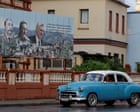
A vintage car passes by images of the Fidel Castro, Raúl Castro and Cuba's President Miguel Díaz-Canel displayed on a billboard in Havana on 15 May.
Photograph: Norlys Perez/Reuters A vintage car passes by images of the Fidel Castro, Raúl Castro and Cuba's President Miguel Díaz-Canel displayed on a billboard in Havana on 15 May.
Photograph: Norlys Perez/Reuters Nervy time for Havana neighbours of top officials as fears of US attack grow Cubans express outrage at US charges against Raúl Castro but view military strikes as serious possibility A new question in being asked in Havana as people digest the news that the US has brought criminal charges against Cuba’s 94-year-old former president, Raúl Castro : who’s your neighbour?
If you happen to live near a senior figure in Cuba’s government or armed forces, others suck their teeth in an expression of concerned sympathy. For the first time, US military strikes on the island are being considered a serious possibility.
There is also anger at Washington, from a population that had previously lost its faith in its own government. “How dare they?” said a teacher in Havana, who was considering attending a march against the indictment on Friday morning. “I’d never normally go to something like that, but it’s despicable. Who are they to threaten us in such a way?” In 1996, protesters gather at the Brothers to the Rescue hangar at Opa-Locka airport, Florida, after Cuba shot down two planes.
Photograph: Chuck Fadely/TNS/Zuma Press Wire/Shutterstock It’s now 30 years since Cuban fighter jets shot down two unarmed Cessna planes belonging to the exile group Brothers to the Rescue in international airspace just north of Havana. Four people died. At the time, it was seen not only as an atrocity, but a terrible strategic error. Now the incident is at the heart of the US indictment of Castro .
US indicts former Cuban president Raúl Castro as it seeks to oust regime Read more What is less remembered is that it wasn’t a surprise. I covered the story from Miami, where Eloy Gutiérrez Menoyo – the first rebel leader to enter Havana under Fidel Castro but by then living in exile – told me: “Everybody here knew something was going to happen to the planes.” Brothers to the Rescue was a group originally founded by a Bay of Pigs veteran José Basulto to spot Cuban refugees trying to reach the United States on makeshift rafts. By the mid-90s, it had turned to provocation by buzzing Cuba itself and dropping leaflets – something Fidel Castro himself said the US would never tolerate over its own capital, according to the book Back Channel to Cuba, by William LeoGrande and Peter Kornbluh.
A Brothers to the Rescue plane flies over the Democracy Movement flotilla at the 12-mile limit north of Havana on 10 July 1999.
Photograph: Alan Diaz/AP “Their most provocative act in 1995 came on July 13, when Basulto’s Cessna Skymaster buzzed Havana, raining down thousands of religious medallions and leaflets reading ‘Brothers, Not Comrades’,” they wrote.
Despite pleas from the Cuban government, the US continued to tolerate the flights and eventually the Cuban leadership snapped. “Fidel was trying to find a diplomatic solution, he had sent several messages to Bill Clinton saying, ‘You have to stop this, we cannot stand it,’” said Carlos Alzugaray, who was Cuba’s ambassador to Brussels at the time.
The pressure the Cuban government was facing then, however, was nothing to what it is now.
Wednesday’s indictment follows weeks in which surveillance aircraft have circled the island, suspect intelligence reports have suggested that Cuba has drones and therefore poses a threat to the US , the CIA director landed in Havana to tell Cuban officials to stop cozying up to Russian and China, and the aircraft carrier group Nimitz entered the Caribbean.
In a speech directed to the Cuban people, Marco Rubio , the Cuban American US secretary of state, said: “You, who call the island your home, are going through unimaginable hardships. Today I want to tell you what we, in the US, are offering to help you not only alleviate the current crisis, but also to build a better future.” Cubans gather in front of their houses during a blackout in Havana on 16 March. Blackouts have become the norm amid the US energy blockade.
Photograph: Adalberto Roque/AFP/Getty Images He blamed the Cuban government for the 22-hour blackouts Cubans are enduring, despite the four-month US oil blockade – and nearly 70-year embargo. But he also cleverly played to Cuban concerns about the proportion of the economy controlled by the Cuban military.
“They buy fuel for their generators and their vehicles while the people are asked to sacrifice,” he said.
It was widely seen in Cuba as a clever and well-informed speech. Recently Rubio had offered Cuba $100m in aid, which on Thursday he said had been accepted, but he did not confirm whether Washington would agree to Havana’s terms.
Alongside such efforts to make Cuba dependent, US sanctions have been effective in driving out non-US businesses operating in Cuba. On Thursday, World2Fly, a Spanish charter airline joined the many others that have stopped flying to the island.
Cubans in exile hold up a sign that reads ‘Assassins and terrorists’ as they celebrate Cuba’s Republic Day in Miami, Florida, on 20 May 2026.
Photograph: Cristóbal Herrera/EPA Donald Trump has repeatedly made clear he wants to “free” Cuba for his Cuban American friends in Miami. Concerns that this will involve creating an American protectorate, were not helped by a Bloomberg report on Wednesday that revealed the Canadian nickel miner Sherritt, a major force in the Cuban economy, is in talks with Ray Washburne, a former Trump adviser, to hand over a controlling stake.
“I think this is a pretty good introductory course to the sort of barefaced corruption that would accompany any sort of US control over Cuba,” said a European businessman who works in Cuba.
It was such overweening US control that originally led to the Cuban revolution.
Luis Raul González-Pardo Rodríguez in the Cuban air defense force.
Photograph: DOJ Perhaps the most inevitable part of the story is that one of the Cuban MiG pilots alleged to be involved in shooting down the planes arrived in the US in 2024 as part of a wave of immigration that has seen Cuba lose 20% of its population since 2021. Luis González-Pardo Rodríguez, already facing charges of immigration fraud , was indicted on Wednesday alongside Raúl Castro.
“The indictments should have happened – not in the US, but in a post-Castro Cuba. All these crimes – including many we don’t know about – will come out and it should be for the Cuban people to decide whether there are trials or a process of reconciliation and forgiveness,” said Manuel Barcia, a Cuban who is now pro-vice-chancellor at the University of Bath.
Whether the US will now try to abduct Castro, as it did Nicolás Maduro from Venezuela , remains to be seen.
“How far do they want to go with this?” asked the former ambassador Carlos Alzugaray. “Are they really going to come in and abduct a 94-year-old guy?” Explore more on these topics Cuba Americas Caribbean US foreign policy Marco Rubio Raúl Castro news Share Reuse this content