
We now pause for a word from our sponsors.
Story text Size Small Standard Large Width * Standard Wide Links Standard Orange * Subscribers only Learn more It’s difficult to know the true state of the Russian economy, both because the country’s financial reporting is sparse and because official figures are unreliable. But things probably aren’t great.
This week, Sweden’s minister of foreign affairs, Maria Malmer Stenergard, shared her country’s assessment that the Russian economy has likely contracted over the last five years amid the war in Ukraine. Inflation is also high, and international sanctions have cost Russia $450 billion since the onset of the war in February 2022. Russia’s economy is currently smaller than that of Texas, Stenergard said.
By most measures, then, the economy is not in tip-top shape. Moreover, the war is draining a large amount of the country’s financial resources, with defense spending reaching a post-Soviet record of about 7 percent of government spending.
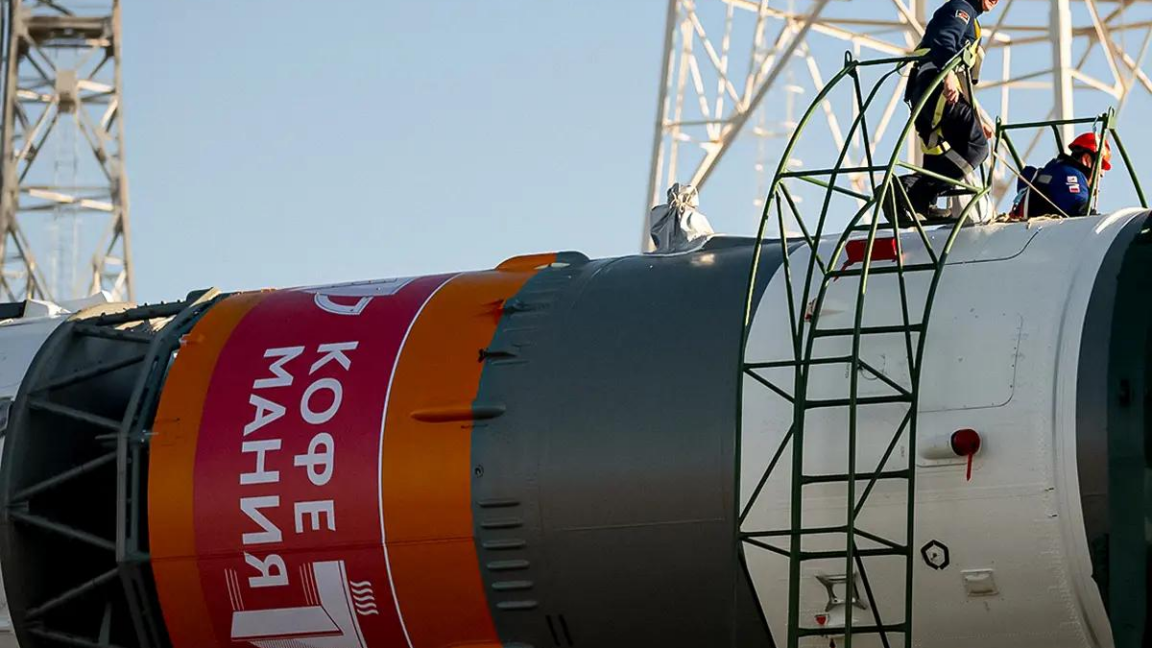
So perhaps it shouldn’t be a surprise that Russia’s beleaguered space program is turning to alternative sources of revenue: Since January 1, Russian rockets have been regularly plastered with advertising for banks, restaurants, and more.
Building on history Advertising in space, especially with the Russian space program, is nothing new. Thirty years ago, for example, Pepsi paid about $5 million to have a cosmonaut film a large Pepsi can replica outside the Mir space station. In 2000, Pizza Hut paid to have its logo painted on a Proton launch vehicle sending a spacecraft to the International Space Station.
However, these have largely been one-off measures. Now, Russia has made space advertising part of its official space policy.
Last fall, President Vladimir Putin, who has served in that role for all but four years this century, approved changes to federal laws governing advertising and space activities to allow for the placement of advertising on spacecraft.
“According to the amendments, Roscosmos has been granted the right, effective January 1, 2026, to place advertising on space objects owned by both the State Corporation itself and federally,” the state-owned space corporation, Roscosmos, said. “The amendments will create a mechanism for attracting private investment in Russian space exploration and reduce the burden on the state budget.” Raising small amounts so far So Russia entered the brave new world of pervasive space advertising a few months ago. The Russian business newspaper Vedomosti reported that six large s have been placed on Russian rockets in 2026. These include ads for PSB Bank, the Kofemaniya restaurant chain, the Russian Media Group, and the Russian Olympic Committee. The other two were public service announcements.
Will this help?
Like other segments of the Russian economy, Roscosmos has been subject to Western sanctions since the outbreak of the war against Ukraine. International partners, particularly the European Space Agency and commercial customers, stopped purchasing launches on Soyuz and Proton vehicles.
According to some estimates , the sanctions cost Roscosmos $2.5 billion since the start of the war.
The new advertising won’t offset those losses in a meaningful way. Annual revenues from space advertising may only amount to a few million dollars per year, Russian news sources say.
A flagging launch rate As with the overall economy, it’s difficult to get a true sense of the health of the Russian space program. But from the outside, there are some grim signs. For example, Russia recently extended its human spaceflight missions to the International Space Station from six to eight months to reduce the number of Soyuz rockets and spacecraft used by the program.
And the overall health of the Russian launch industry continues to decline. In both 2024 and 2025, the total number of Russian launches fell to 17 annually. Excluding 2020, the height of the COVID-19 pandemic, this is the lowest total number of annual launches in Russia since 1961, the year Yuri Gagarin launched into space.
At its height, in the early 1980s, Russia regularly launched 100 orbital rockets a year.
Eric Berger Senior Space Editor Eric Berger Senior Space Editor Eric Berger is the senior space editor at Ars Technica, covering everything from astronomy to private space to NASA policy, and author of two books: Liftoff , about the rise of SpaceX; and Reentry , on the development of the Falcon 9 rocket and Dragon. A certified meteorologist, Eric lives in Houston.
17 Comments