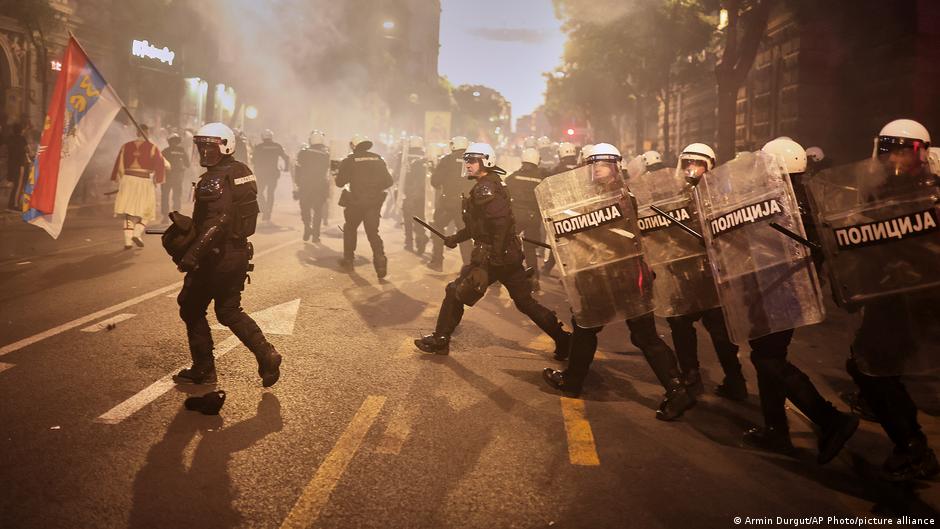
Officers fired teargas and stun grenades as tens of thousands rallied against President Aleksandar Vucic's government. The demonstration went ahead despite the state rail operator canceling trains to and from Belgrade.
The populist leader has been accused by critics of consolidating power and undermining democratic checks and balances.
The protest movement erupted some 18 months ago after 16 people were killed when a newly-renovated roof collapsed at a major railway station , blamed on corruption and negligence.
What happened at the latest protest?
According to media reports, tens of thousands of people joined the rally, with many protesters wearing T-shirts with the slogan "Students win" or carrying Serbian flags or banners bearing the names of their town or city.
While the main protest was mostly peaceful, groups of young demonstrators later split and clashed with police, throwing flares, rocks and bottles. Riot police responded with tear gas and stun grenades as they charged forward to disperse them.
During the protest, participants called for early parliamentary elections, accused the government of crime and corruption and demanded the return of the rule of law.
The rally, in Belgrade's Slavija Square, was the scene of a huge anti-government protest in March 2025 that drew 300,000 people before ending in controversial circumstances.
During that rally, the government denied using a sonic weapon against the protesters, which independent experts later confirmed.
Student uprising sparked by Novi Sad disaster The student movement emerged after the deadly collapse of a 48-meter concrete canopy at a railway station in Serbia's second-largest city, Novi Sad, in November 2024.
Sixteen people died in the tragedy, which happened shortly after a renovation of the station as part of a major Chinese-funded infrastructure project The collapse was blamed on poor workmanship and inadequate oversight, sparking a huge public outcry.
In the aftermath, then-Prime Minister Milos Vucevic was forced to resign, while Vucic launched a crackdown on the protest movement after some of the rallies turned violent.
Vucic and pro-government media outlets have recently ramped up political rhetoric against his critics, labeling them as terrorists and foreign agents who wish to destroy the country.
Serbia is formally seeking European Union membership, but maintains close links with Russia and China.
The country's democratic backsliding under Vucic could cost the country around €1.5 billion ($1.8 billion) in EU funding, the bloc's top enlargement official warned last month.
On Friday, the Council of Europe’s human rights commissioner raised serious concerns about Serbia's deteriorating human rights situation, highlighting increasing attacks on journalists and activists, shrinking civic space and reports of police violence during protests.
International concern about rule of law in Serbia To view this video please enable JavaScript, and consider upgrading to a web browser that supports HTML5 video Edited by: Dmytro Hubenko Don't let the algorithm hide the news. If you rely on our team for trusted reporting, please take a moment to select us as your Preferred Source on Google by clicking here and hitting the "star" or "preferred" button , so you'll always see our verified news first.