
Attack marks first time military action has forced a fully operating nuclear power plant to rely on backup generators• Middle East crisis – live updatesA drone strike that cut off external power to a nuclear reactor in the United Arab Emirates this week has revived concerns over the safety of nuclear plants during wartime.R
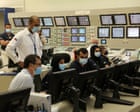
Staff working at the Barakah nuclear power plant in 2020. Reactor no 3 lost off-site power for about 24 hours after the attack.
Photograph: WAM state news agency/AP Staff working at the Barakah nuclear power plant in 2020. Reactor no 3 lost off-site power for about 24 hours after the attack.
Photograph: WAM state news agency/AP Analysis Strike near UAE reactor revives concerns over nuclear plant safety in wartime Dan Sabbagh Defence and security editor Attack marks first time military action has forced a fully operating nuclear power plant to rely on backup generators Middle East crisis – live updates A drone strike that cut off external power to a nuclear reactor in the United Arab Emirates this week has revived concerns over the safety of nuclear plants during wartime.
Reactor no 3 at the Barakah nuclear plant lost off-site power, which is critical for its own functioning, for about 24 hours after the attack on Sunday, forcing it to rely on emergency diesel generators.
Iran, or one of its regional proxies, is likely to have been behind the strike. One of three drones got through from the west, causing a fire close to a four-reactor plant that supplies the UAE with quarter of its electricity.
The UAE said the strike hit an electrical generator “outside the inner perimeter”, raising fears it could have hit the switch yard which lies just beyond a wall around the site’s reactors.
Graphic using satellite image to show location of unit 3 of Barakah nuclear plant It is the first time a fully operating nuclear power plant has had to rely on backup generators as a result of a military attack, at a time when reactors in Ukraine and Iran are also threatened by war.
The UAE’s nuclear safety regulator said the attack did not cause any radioactive material to be released, though it was notable that it had not proved possible to completely defend a critical site from drones.
Experts told the Guardian there should have been sufficient power available from the other three reactors on-site, but this does not seem to have immediately been the case, possibly because of damage to the switch yard, which routes electricity in and out.
On Monday, the International Atomic Energy Agency said it had been told by the UAE that off-site power to unit No 3 had been restored “earlier today”, meaning that “the reactor no longer needs emergency diesel generators for power”.
Rafael Grossi, the head of the IAEA nuclear watchdog, said nuclear sites and other installations important for nuclear safety must never be targeted by military activity.
External power is critical to keep reactor cores sufficiently cool. All nuclear sites have backup generators to maintain power in an emergency, should the outside supply be lost.
At the Fukushima Daiichi nuclear plant in Japan, in 2011, three reactor cores melted down after a tsunami caused by an earthquake overwhelmed the backup generators. Though the fuel was contained, about 160,000 people had to be evacuated.
A young evacuee is screened for leaked radiation from the Fukushima Daiichi nuclear power plant.
Photograph: Wally Santana/AP The World Nuclear Association, a trade body representing the nuclear industry, said: “We call on those responsible for military activity of any kind in the proximity of this nuclear power plant, and all civilian energy facilities, to revisit the agreements of the Geneva conventions.” Though the Geneva conventions , which set out laws of warfare, insist that civilian objects, including nuclear plants, “are protected against attack”, they accept they can be attacked “for such time as they are military objectives” – a loophole that aggressor states have interpreted widely.
Worries about attacks on nuclear sites and the potential risk to civilians escalated dramatically after Russia’s invasion of Ukraine and, more recently, the US-Israeli attack on Iran.
On Tuesday, Donald Trump said he had held off a fresh attack on Iran at the request of the leaders of Qatar, Saudi Arabia and the UAE, as the crisis in the Middle East remains deadlocked.
A month earlier the US president threatened to bomb Iran’s power plants as part of an attack to try to force Tehran to yield, though he then agreed to a ceasefire .
There remains concern, however, that Iran’s Bushehr nuclear plant, which has one working reactor, could either be struck directly or lose external power if US and Israel do renew their bombing.
Workers outside the Bushehr nuclear power plant in Iran.
Photograph: Reuters In Ukraine, the Zaporizhzhia nuclear site, seized by Moscow in 2022, remains on the frontline. External power to the six-reactor plant, which has been put into shutdown, was lost for a month in 2025 .
Conventional power plants have been repeatedly bombed by Russia each winter to try to force Ukraine to surrender, but its three functioning nuclear plants have remained relatively unscathed because Moscow has so far considered a direct attack on the sites to be taboo.
Explore more on these topics Drones (military) Nuclear power Energy industry US-Israel war on Iran United Arab Emirates Energy Middle East and north Africa analysis Share Reuse this content