Situation described as ‘deeply worrisome’ by officials as aid cuts and community distrust impede respondersThe Ebola outbreak in the Democratic Republic of the Congo poses a “very high” risk to the country, the World Health Organization said on Friday, revising its threat assessment upwards.The outbreak is spreading rapidly, WHO leaders said, with almost 750 suspected cases and 177 suspected deaths, up from 246 cases and 65 deaths when it was first reported a week earlier. <
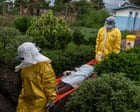
Medical staff carry an Ebola patient to a treatment centre in Rwampara, Congo, 21 May. There have been 177 suspected deaths from the disease so far.
Photograph: Moses Sawasawa/AP Medical staff carry an Ebola patient to a treatment centre in Rwampara, Congo, 21 May. There have been 177 suspected deaths from the disease so far.
Photograph: Moses Sawasawa/AP Suspected Ebola cases triple in a week as WHO warns of rapid spread in DRC Situation described as ‘deeply worrisome’ by officials as aid cuts and community distrust impede responders The Ebola outbreak in the Democratic Republic of the Congo poses a “very high” risk to the country, the World Health Organization said on Friday, revising its threat assessment upwards.
The outbreak is spreading rapidly, WHO leaders said, with almost 750 suspected cases and 177 suspected deaths, up from 246 cases and 65 deaths when it was first reported a week earlier.
The situation is “deeply worrisome”, said Dr Tedros Adhanom Ghebreyesus, the WHO director-general.
On Thursday, tents and medical supplies outside a hospital in Rwampara, Ituri province, were set on fire as medics tried to set up an Ebola treatment centre. A crowd was reportedly angry at not being allowed to retrieve the body of a local man who had died at the hospital. The bodies of Ebola patients must be buried according to strict infection control protocols to prevent further spread.
Medical staff carry disinfectant to a hospital in Rwampara on 21 May. An Ebola treatment centre at the hospital was attacked on Thursday.
Photograph: Seros Muyisa/AFP/Getty Images Tedros warned that “significant distrust of outside authorities among the local population” was causing issues for the response to the outbreak.
“Building trust in the affected communities is critical to a successful response, and is one of our highest priorities,” Tedros said.
The WHO’s representative in the DRC, Dr Anne Ancia, said the incident in Rwampara would “significantly jeopardise” the response operation there.
The treatment centre that was attacked was designed to separate Ebola patients from others being treated in the same hospital. Ancia said she was hopeful that it would be able to be up and running again within 24 hours.
The outbreak has been caused by the Bundibugyo strain of Ebola, for which no vaccines or treatments exist. Most cases are in the DRC’s Ituri province, with a handful reported elsewhere in the country, and two in neighbouring Uganda.
Rising case numbers may paradoxically be a “good sign”, indicating better detection, officials said. A slight fall in the number of samples testing positive suggests more people with potential symptoms are being picked up.
However, Ancia said: “We are running behind, we are not yet under control.” As WHO sounds alarm over Ebola in DRC, what can be learned from previous outbreaks?
Read more She was confident, however, that the response would be successful.
“I can guarantee you that together, we will manage to get over this outbreak as soon as we can,” she said.
While the WHO raised its risk assessment for the DRC, it maintained its earlier assessment that there was a high risk at the regional level and low risk at the global level.
Health workers disinfect an isolation ward at a hospital in Mongbwalu, DRC. A lack of staff and equipment is making the response more challenging.
Photograph: Michel Lunanga/Getty Images Representatives of humanitarian organisations working in Ituri said they did not yet have enough resources to mount an adequate response.
Dr Amadou Bocoum, country director for Care International in the DRC, said aid cuts last year meant “the system was not able to work properly because of lack of equipment”, while lower staff levels also made the labour-intensive work of informing cases and contact tracing harder.
Julie Drouet, country director for Action Against Hunger, said: “Everyone is working to try to implement as quickly as possible … the response in the field, however it is not quite yet ready. It is not really yet up to the emergency that we have in Congo at the moment.” A WHO press briefing also heard that scientists had identified an antiviral drug, obeldesivir , which may be able to prevent contacts of Bundibugyo cases developing the disease, and were working to establish trials in the affected areas.
Explore more on these topics Global development Ebola Infectious diseases Democratic Republic of the Congo World Health Organization Health Africa news Share Reuse this content