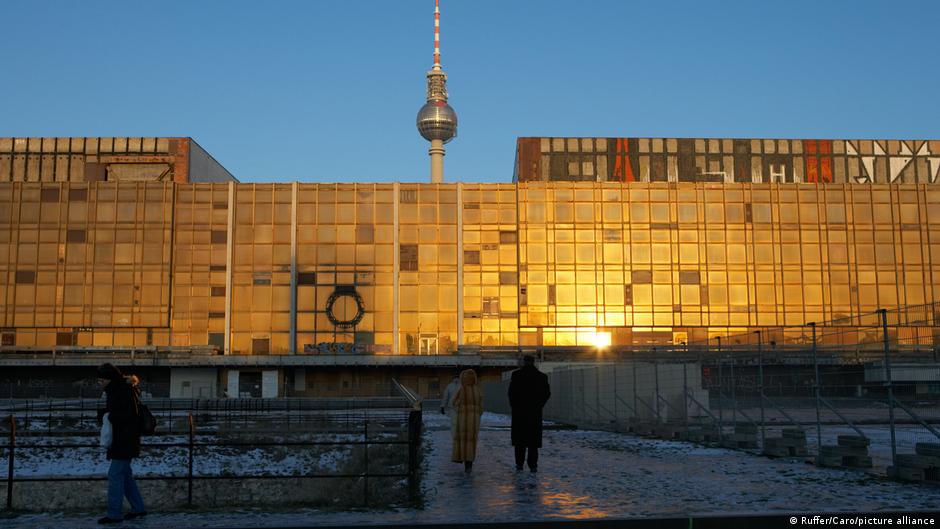
From 1976 through 1990, the building in East Berlin served as a symbol of the communist state's power. The "People's Palace" was controversially destroyed — and yet remains present.
From its opening 50 years ago through its controversial destruction in 2006-08, the iconic building embodied the ideals and promises — or for many, failed promises — of the German Democratic Republic (GDR) .
Even today, in its structural absence, its legacy lives on, a memory that reveals the debates and complexities woven into German history .
The leadership of East Germany's communist party (SED), the de facto ruling power, decide they need a building that lives up to their modern, self-assured image. It is to be a "house of the people" ("Haus des Volkes"), an institution that represents socialist values while also serving as a place of culture and entertainment for East German citizens.
Construction on the Palace of the Republic begins in 1973. The goal: to have it completed in just three years' time. The GDR pours money, materials and labor into its construction, often at the expense of other building projects.
Right on schedule, the palace opens to the public on April 23, 1976.
"The furnishings are of the finest quality. No expense was spared on either material or money," reported a West German correspondent covering the palace's inauguration.
"It was always full, always full of people. Something was always going on, whether it was someone in some corner reading poetry aloud or a small group playing music. There were also a ton of small shops, where things were being sold that you couldn't otherwise get," recalled Hans-Peter Tennhardt, an acoustic technician at the palace, in an interview for a German museum publication .
And for others still, it is the manifestation of the SED's inescapable dictatorial power.
People felt all different ways about the building, says Mareen Maass, a museum program manager who conducted dozens of interviews about the palace and people's relationships to it for a historical project.
"For some, it was a symbol of the German Democratic Republic's oppression time, because it was an official place to go to. It took a lot of money to build that building, so they were very critical because they said all the money went to this place while various other places in the periphery really lacked of a lot of things," Maass told DW.
Whether they love, hate or are indifferent to the palace, its closure coincides with a pivotal moment of transition in their lives, the end of their lived realities, from the jobs they had done, in some cases, to the restrictions on their freedom.
"For many people in Eastern Germany, it was a really symbolic place connected to their lives," Maass said. Its closure was a "bigger sign for them." Over the coming decade, the palace is slowly decontaminated. Everything from fixtures to insulation is taken out, leaving only the frame behind.
For a few years in the mid-2000s, the skeletal structure is open to artists to use as an exhibition and performance space, and some push to continue this. Others see the palace's ultimate removal as an attempt to try and erase East German history from reunified Germany's historical narrative.
From 2006-08 the last vestiges of the Palace of the Republic are dismantled, the steel melted and shipped off for use elsewhere, including in Dubai's Burj Khalifa, the world's tallest tower.
Edited by: Elizabeth Grenier Correction: The national emblem of the German Democratic Republic was a wheat wreath surrounding a hammer and compass, not a sickle. This has been corrected.
Advertisement