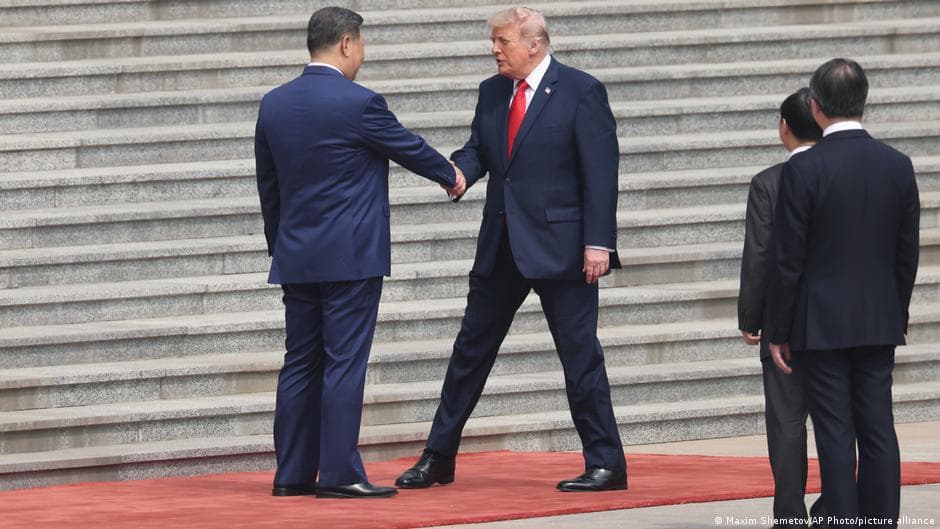
The leaders of the world's two biggest superpowers, China and the United States, have kicked off a meeting amid heightened geopolitical tensions. Follow DW for more.
Skip next section What events are planned during Trump's China visit?
05/14/2026 May 14, 2026 What events are planned during Trump's China visit?
Then there's some cultural programming, such as a visit to the Temple of Heaven, before a state banquet at the end of day.
Trump's trip is expected to be long on pageantry and symbolism.
But neither side has offered any major concrete details on what is expected from the talks.
The top topics for discussion are expected to be the Iran war , trade between the two nations , technology and US weapons' sales to Taiwan .
Trump is expected to leave just after midday Friday after a final private meeting with Xi.
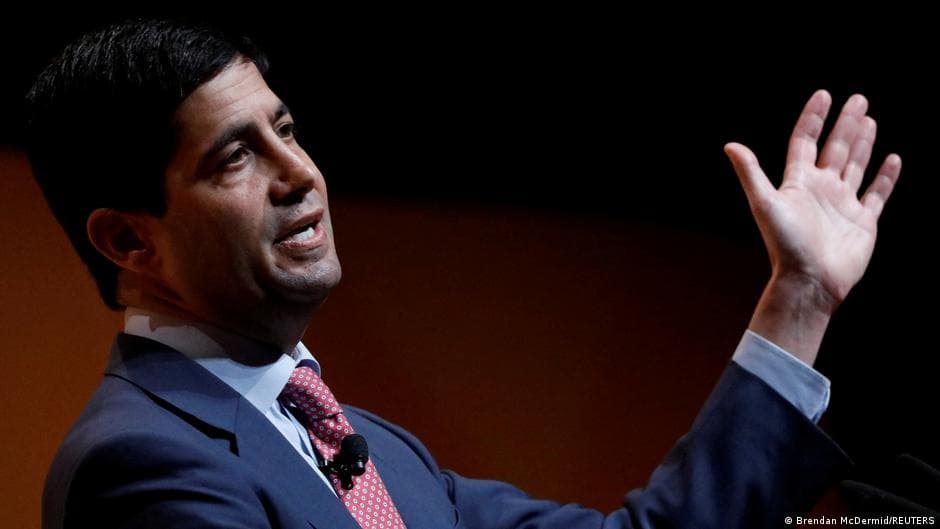
The Iran war is a "huge source of instability" and "threatens to destabilise Asia more than any other part of the world because it's heavily reliant on the straits for energy," he said, refering to the Strait of Hormuz which is effectively blocked to most international shipping.
"It's in [China's] interest to resolve this," he said.
China maintains ties with Iran and remains a major consumer of Iran's oil exports .
Trump has been leaning on China to use its influence to push Iran to make a deal with the US.
War with Iran casts shadow over Trump's visit to China To view this video please enable JavaScript, and consider upgrading to a web browser that supports HTML5 video https://p.dw.com/p/5Djly Skip next section Welcome back to our coverage 05/14/2026 May 14, 2026 Welcome back to our coverage Kate Hairsine | Sean Sinico Editor US President Donald Trump has arrived in Beijing for a highly anticipated summit with Chinese leader Xi Jinping on Thursday.
For background on the hot topics influencing the relationship between China and the United States , take a look at our US-China blog from Wednesday May 13 .
And we'll bring you the latest developments and analysis from the Trump-Xi summit as events unfold.
"We are in constant contact with our American partners," Zelenskyy told a summit in Romania.
"We are thankful, and we are expecting that the issue of ending of the Russian war against Ukraine will be raised now as well, while the president of the United States is in China," he added.
China is a close partner of Russia, and has maintained a neutral stance on Moscow's invasion of Ukraine.
"The mutual trust between China and Russia grows ever deeper, with pragmatic cooperation forging an unbreakable bond," Xi said when visiting Moscow in May 2025 In data reported in 2025, China was Russia's top economic partner, with bilateral trade soaring to $244 billion (€216 billion) in 2024. In February 2022, the two countries signed a "no limits" economic, military, and diplomatic partnership to counter Western influence.
The US has in the past accused China of providing material support for Russia by providing parts for weapons production, and economic support by buying Russian oil .
China and Russia: A partnership of equals?
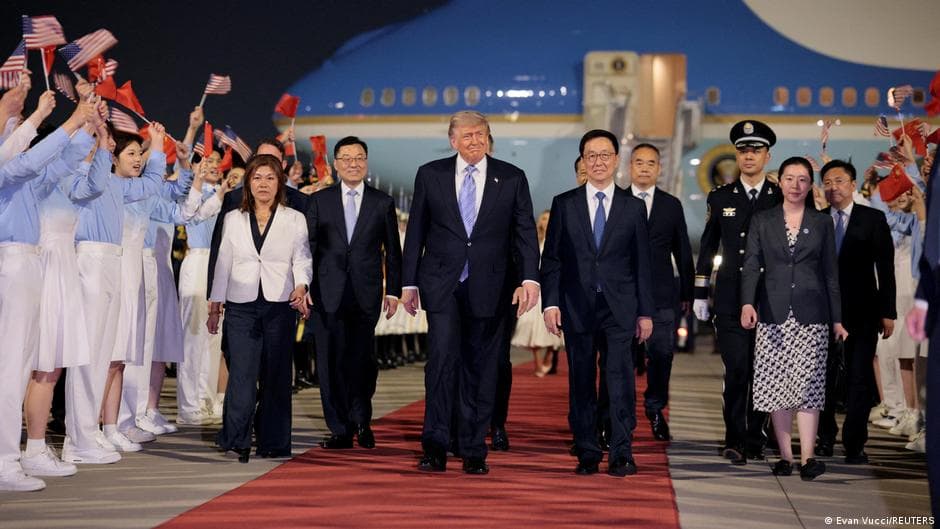
As Trump disembarked from Air Force One onto a red carpet, Chinese students waved US and Chinese flags and chanted "welcome" in Mandarin.
Trump paused and raised his fist in the air, before departing in a limousine.
Trade : Tariffs are expected to be a major part of the agenda as the US and China restarted a a trade war last year after Trump singled out China during his global tariff blitz.
The highest tariffs were walked back after China threatened to choke off rare earths , and a summit in October yielded tentative agreements on trade Both sides will be looking to build on progress, with Trump saying he wants China to buy more US goods, Taiwan : Self-ruled Taiwan is a red line for Beijing. The US policy is that it "does not support" Taiwanese independence. But China could see an opening with Trump in pressing the US to actively "oppose" it.
US arms sales to Taiwan are also something Beijing bristles at, and Trump said before leaving it would be part of his talks with Xi.
Artificial intelligence : Trump and Xi are sure to discuss AI, as it remains a key area of competition between the US and China.
China wants access to the most advanced chips used to develop and deploy frontier AI models, which currently are produced by US chip giant Nvidia. Jensen Huang, Nvidia's CEO, is part of Trump's business entourage in Beijing.
The Trump administration has allowed the sale of some less advanced Nvidia tech to China for a cut of the profits. A deal on more Chinese access to US tech would be lucrative for Beijing.
US Treasury Secretary Scott Bessent and Chinese Vice Premier He Lifeng had three hours of talks in Seoul to prepare for a summit between Donald Trump and Xi Jinping in China.
US and Chinese officials did not give an immediate summary of what the discussions entailed. Bessent is due to join Trump in Beijing later on Wednesday.
Both Bessent and He also held separate meetings with South Korean President Lee Jae Myung at the presidential Blue House.
At that meeting, Trump lavished praise on Chinese leader Xi Jinping, marking a stark contrast to his previous criticism of China. Xi also gave Trump a grand welcome with a "state plus" visit that made it quite memorable.
Trade was a flashpoint issue then, too. Trump has long accused China of unfair trade practices, while the Chinese argument has been that the relationship has benefited Americans in the form of cheap goods and increased Chinese investment in the US.
In 2017, Trump asked Xi to "work very hard" on persuading North Korea to denuclearize. Overall, both sides were cordial. Trump then met Xi Jinping in summits in 2018 and 2019.
Trump agreed to lower tariffs previously used to pressure cooperation on combating the fentanyl crisis. For its part, China committed to purchasing US soybeans and also agreed to postpone by a year its proposed export controls on rare-earth minerals.
"I’m going to have that discussion with President Xi," Trump said. But the words alarmed allies since that would break with the traditional US policy of maintaining "strategic ambiguity" that is designed to avoid provoking either side.
The policy means that the US is bound by law to ensure Taiwan's ability to defend itself even though it officially acknowledges Beijing's position that Taiwan is part of China.
Xi Jinping is expected to try to press Trump to shift US rhetoric closer to Beijing's position in a bid to isolate Taiwan, and while Trump is eager to persuade China to use its leverage over Iran.
At the same time, Taiwan has become essential for the development of artificial intelligence technology since it's the world's leading chipmaker.
Trump becomes the first US leader in nearly a decade to visit China, after his 2017 visit during his first term in office. The summit offers leaders of both countries a chance to reset ties and find common ground on a range of issues.
Experts said the preparatory talks between Bessent and He were meant to lay the groundwork for the summit rather than seeking breakthroughs. Bessent then travels to China later today.
China's lead trade negotiator, Vice Commerce Minister Li Chenggang, and Vice Finance Minister Liao Min were among the officials accompanying He.
China tightens its grip on global business To view this video please enable JavaScript, and consider upgrading to a web browser that supports HTML5 video https://p.dw.com/p/5Dfu2 Skip next section China repeats its strong opposition to US arms sales to Taiwan 05/13/2026 May 13, 2026 China repeats its strong opposition to US arms sales to Taiwan Zhang Han, a spokesperson for China's Taiwan Affairs Office, said Taiwan is an internal issue and a matter for the Chinese people.
"We firmly oppose the United States engaging in any form of military ties with China's Taiwan region and firmly oppose the United States selling weapons to China's Taiwan region. This position is consistent and unequivocal," she said during a weekly briefing in Beijing on Wednesday.
In December, the Trump administration announced an $11 billion (€9.4 billion) weapons package for Taiwan , the largest ever.
US riles China with $11 billion arms deal for Taiwan To view this video please enable JavaScript, and consider upgrading to a web browser that supports HTML5 video Taiwan is the "core of China's core interests" and honoring the commitments made by successive US administrations are "international obligations that the US side is duty-bound to fulfil", Zhang added.
China views democratically governed Taiwan as its own territory and has not ruled out using force to exert its control.
Both sides still rely on each other: The US depends on China for rare earth elements and as an export market, while China seeks access to advanced American technologies like semiconductors .
Ahead of Donald Trump's visit to Beijing, both governments aim to stabilize relations and avoid further tariff escalation, especially as global economic pressures mount due to the conflict in Iran. Analysts describe the meeting as a "risk‑management summit," with China potentially positioned as a mediator in the Middle East to help secure vital trade routes such as the Strait of Hormuz .
The meeting comes as the world faces an ongoing energy crisis due to the Strait of Hormuz blockade and peace negotiations between Tehran and Washington seem to be deadlocked. Meanwhile, entrenched trade disputes between China and the US still lurk from behind the scenes.
Against this backdrop, both countries have an incentive to ensure the meeting between the two leaders comes off as a success. Neither Trump nor Xi are ready to lose face. Both want to remain the "strong man." Read the full analysis here https://p.dw.com/p/5DfsM Show more posts