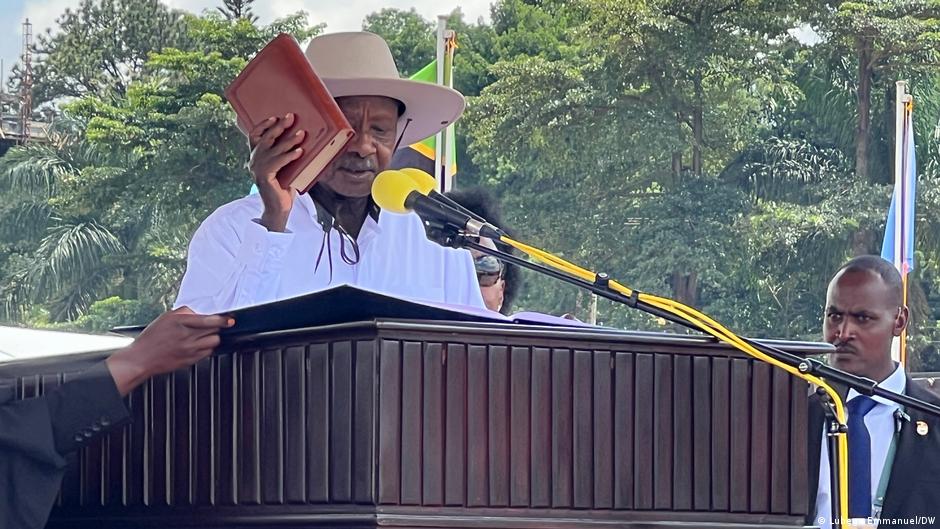
Unemployment and poverty pose major challenges for President Museveni's seventh term, while his age and long rule prompt questions about Uganda's future beyond his leadership.
Regional leaders, including the Democratic Republic of Congo's Felix Tshisekedi, Samia Suluhu Hassan of Tanzania, Nigeria's Bola Tinubu, and former Kenyan President Uhuru Kenyatta traveled to Uganda's capital, Kampala, for Museveni's inauguration, highlighting his regional diplomatic standing.
Despite winning January's elections with just under 72% of the vote — amid reports of intimidation and abductions of opposition figures — many believe the 81-year-old is nearing the end of his time in office. But, according to the Ugandans DW spoke to about what they hope for in Museveni's seventh consecutive term, there is still plenty to do.
Uganda's economic growth fails to reach young population Most Ugandans seem to agree that under Museveni, Uganda has experienced significant political stability and economic growth — an achievement not to be underestimated in a region plagued by armed insurgencies and political unpredictability .
Uganda's gross domestic product (GDP) growth exceeded 6% in 2024, according to the World Bank , and has and has remained relatively strong for decades, typically above 3% since the early 1990s. Uganda's GDP rose from $3.9 billion in 1986 to more than $53.9 billion in 2024.
Uganda's population has surged from just 15.5 million in 1986 to over 50 million in 2024, resulting in one of the world’s youngest populations, with a median age of around 17 — while unemployment remains a major concern for young Ugandans .
"We have a very big population. The majority of them are youth, and a number of these are unemployed. It's a time bomb," journalist Robert Kirabo told DW in Kampala.
"Ugandans want to see accountability," Agnes Atim Apea, a development economist and former MP for Molata, told DW. "They're hearing the economy is growing, but our people now want to start feeling that growth." Museveni did seem to recognize these factors in his inaugural address, promising wealth creation, anti-corruption efforts, and improved service delivery across health, education, and infrastructure.
Justus Kiiza, a street vendor, said: "In the last term, the president did not handle the matters of traders and vendors adequately." Jovlet Sarah Nankinga, a student at Makerere University in Kampala, told DW that the embezzlement of public funds was a problem, adding the state also needed to "improve financing for youth and entrepreneurs." Job creation aside, there are governance issues, too. Isaac Tenywa, a farmer from Namutumba in eastern Uganda, told DW that Uganda's biggest hurdles would be looming disputes over land ownership, government reluctance to change policies, and tackling a bloated administration.
"That calls for reducing the number of staff, reducing the number of parliamentarians, where most of government revenue goes," Tenywa said. "It is really hard because it involves people losing their jobs and going back to the private sector." Ugandan politics intensifies Rights groups and the United Nations have warned that civic space in Uganda is shrinking and political repression is rising, citing arrests of opposition figures, curbs on media and tighter controls on civil society.
Ugandan opposition leader Bobi Wine was photographed driving through clouds of pepper spray to reach a rally, before losing the election and leaving the country.
"In the last 15 years, I think we have seen a narrowing space for people to openly criticize government activities and programs, and a narrowing tolerance for opposing views," Mbaine told DW.
This is in addition to strict anti-LGBTQ+ laws, and the Ugandan parliament passing a watered-down Protection of Sovereignty Bill, which limits outside funding for political parties.
Even away from the campaign trail, some older Ugandans, like Henry Baguma in Kampala, worry the hardening political atmosphere is affecting service delivery.
"Many things in this country have become so tribalized, they have become so political. Tribalism is very dangerous," he told DW. "Once that becomes the entry point, definitely service delivery becomes a challenge." Who will succeed Museveni?
Museveni's term runs until 2031, and he has not officially named a successor.
"That's a real worry for a lot of us because we thought over time there would be a systematic arrangement for a fairly neat political transition," academic Mbaine told DW.
Museveni's son, General Muhoozi Kainerugaba, is considered a possible candidate. The brash 52-year-old has allies in Uganda's political circles, and leads Uganda's armed forces.
But the stakes are high for the succession to be sorted peacefully, according to Adolf Mbaine: "If we get something that is not even close to a political transition, then it means we have learned nothing. Because we can easily slide back into the kind of chaos that we thought the country had moved on from." Uganda's Museveni election victory: Democracy or deception?
To view this video please enable JavaScript, and consider upgrading to a web browser that supports HTML5 video Frank Yiga in in Kampala contributed reporting.
Edited by: Keith Walker Advertisement