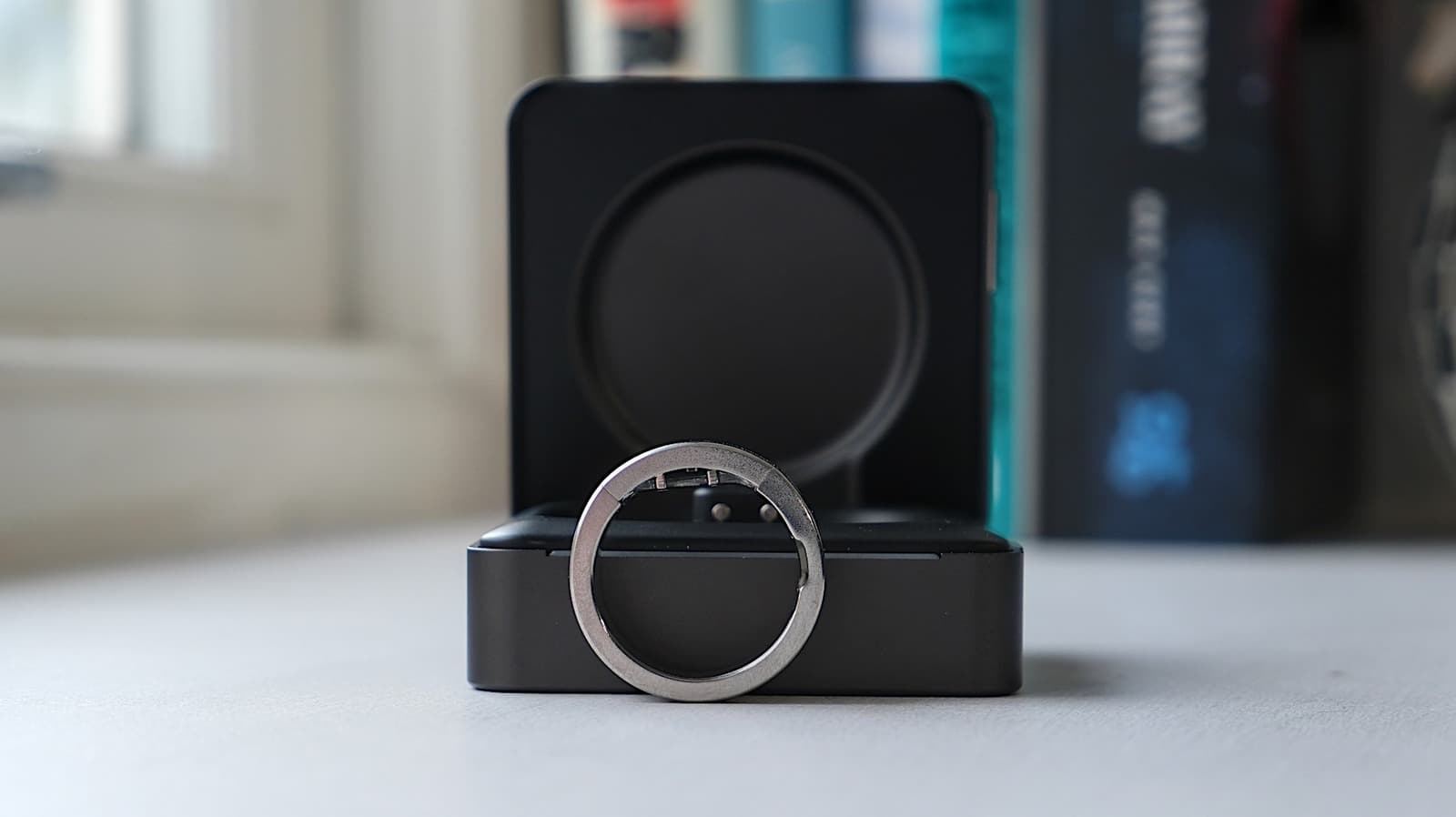
The major innovations on the Ultrahuman Ring Pro are in its charging case.
Reviews Wearables Ultrahuman Ring Pro review: The future of smart rings looks a lot like its present By Daniel Cooper May 14, 2026 10:00 am EST Daniel Cooper for Engadget RATING : 8.9 / 10 Pros Better looking hardware Brilliant charging case Data-rich app Cons Pricier than rivals Not a quantum leap over what went before Depending on who you ask, Ultrahuman is the second or third biggest smart ring maker on the planet. Like Samsung, it's dwarfed by Oura , the undisputed king of the market. It's also one of a handful of companies capable of laying at least a finger on its far bigger rival's hardware and software engineering. The Ultrahuman Ring Pro is, depending on who you ask, an attempt to catch up with, or blow past, the leader. There is just one issue: Given the inherent limitations of the form factor, are there any new features that can be added that would offer a decisive advantage? And if so, what does that mean for the whole industry?
Hardware Daniel Cooper for Engadget Ultrahuman's Ring Pro is a smart fitness tracking ring weighing between 3.3 and 4.8 grams (approx 0.1 oz) (available in sizes 5 to 14. It's the company's first major hardware update since 2023's Ring Air, and has been redesigned from the ground up. Two things prompted the change: First, Ring Air fell foul of an Oura-owned patent which saw it contentiously blocked from sale in the US . Second, the company realized it had done all it could with the Air and needed to radically increase the ring's processing power. The Pro has upgraded silicon to hopefully offer plenty of new insights further down the line.
Consequently, the new model comes with a dual-core chip with onboard machine learning and 250 days of internal storage. That's a big leap from the Air's single-core unit which had just four days of memory to keep track of your vitals. Ultrahuman hopes Jade, the company's new AI, will be able to delve deep and pluck out plenty of conclusions based on these long historical trends. Plus, the company expects to be able to launch a wider variety of Power Plugs — paid-for add-ons tailored to monitoring specific stats — as the ecosystem matures.
It's instantly obvious the Pro is a different beast to the Air, which was made with a titanium outer ring and an epoxy resin interior. When you looked down your finger at the side of the ring you could see the two materials side by side. The Pro is clad in titanium inside and out, except for the resin section housing the PPG sensors. If you're the sort to get your calipers out, you'll find the Pro is just 0.25mm thicker than its predecessor. But the all-titanium body makes it feel a lot chunkier. I didn't notice any meaningful difference while wearing it, but folks with daintier digits than mine may.
As for tracking, you'll get temperature, movement and a PPG sensor the company says is redesigned for better accuracy. Given that's pretty much all the laws of physics will allow you to include in a smart ring these days, there's not much more to say about them. After all, it's not the data you collect but the insights you're able to generate from it that's important. Battery life is rated for 12 days in "Turbo Mode," but you can extend that to 15 days or so with " Chill Mode ," which reduces the amount of tracking to prolong longevity.
The Ring Pro doesn't charge wirelessly. Instead, it uses a physical pin connection on the charging case to reduce thermal issues caused by wireless charging. The ring itself has also been designed to be easily cut open to free your finger in a hurry should the battery start to swell. Naturally, it's rare for a wearables company to talk about these things, so Ultrahuman deserves props for foregrounding it.
I suspect people will be looking for direct comparisons between the Ring Pro and the Oura 4 . Depending on your finger size, they're both a shade under 3mm (0.1 inch) thick and virtually indistinguishable. Up close, the Oura's silver coated titanium is a tad shinier than the raw titanium found on the Pro, but that's about it. The only real differences are in the Pro's slightly more visible sensor zone or the Oura's orientation notch.
Charger Daniel Cooper for Engadget In many ways, the Ring Pro's charger is the bigger draw, given how many new features it ships with. It's a clamshell that immediately evokes Nintendo's Game Boy Advance SP , an austere box designed to sit on a nightstand and draw attention to itself. And it's not just a place to recharge your ring, but it's a far more cohesive and complementary element of the ring's ecosystem.
An LED light strip acts as a charging indicator, letting you keep an eye on how much charge is within the case. Its onboard cell has 45 days worth of charge and can recharge the ring a couple of times when you're on the go. It also has an integrated speaker, proximity tracking and haptic vibrations. The case has a data memory rated for a year as well, so if you neglect to sync your ring to your phone, you aren't at risk of losing your vital statistics.
As mentioned before, thanks to the direct connection, the charger also handles firmware updates which go direct to the ring, rather than being transferred via Bluetooth. Not to mention that, if the update fails and the ring freezes, you can hit the reset button to flash the ring back to its older, more stable software. This should dramatically reduce the number of rings that die during the update process and tackle a key area of customer dissatisfaction.
The case will also be able to find your ring, should you misplace both that and your phone at the same time. But that feature will only be ready for when the rings start shipping, and so I have not had the chance to test it yet.
In-use Daniel Cooper for Engadget Smart rings are limited by their size and form, so there aren't as many data points it can pull from your body. Sleep, heart rate, temperature and basic activity are all there, and that data can then be used to calculate things like menstrual cycle and stress rhythm. Activity tracking is automatic and, as usual, you're expected to confirm your ring's assumptions in the app. The day after I'd walked to the gym, worked out and practiced my boxing, I had to confirm each moment individually, which I found a little vexing. In fact, there are times when I found the ring's activity detection quite lacking — like when it missed a whole hour of me shoveling mud in my garden. (I've had similar gripes with the Oura, which I found lagged behind when I started a task, robbing me of further workout points.) The app will look at your stats and offer suggestions on areas where you should improve in most cases. It suggested I get 30 minutes of activity each day and walk 11,000 steps to get my cardio fitness back where it needed to be. There are moments where, despite all of the stats appearing to be fine, you'll appear to be doing worse than you expect. It told me my cardio age was 48, but didn't explain why given my relatively good VO2Max, resting HR and Heart Rate Variation are all satisfactory for my age cohort. I asked Jade, the system's AI, which then walked me through the specific reasons for my bad score, and how to fix it.
Ultrahuman doesn't charge a monthly subscription to unlock additional features, but you need to buy them on an individual basis. Known as Power Plugs, you'll be able to access specific tracking modes and services relevant to your needs at any given time. This includes custom Les Mills training plans, tailored to your vital statistics and responding to your ring's data. You can get advice and guidance on improving your Vitamin D levels, how well you're driving your Tesla and a way to anticipate migraines. And if you're worried about your heart health, you can pay a small monthly fee to unlock atrial fibrillation detection.
There are dedicated Power Plugs for menstrual cycle and ovulation tracking, as well as to monitor your vital signs during pregnancy. Those are all free, but there's also a paid Pro version which offers the potential for clinically-validated conclusions.
Sleep tracking Ultrahuman Like the rest of the smart ring world, Ultrahuman prides itself on the depth of data it can offer to you. When it comes to sleep, the system will analyze your movement, heart rate and temperature to offer a picture of how well you're getting shut-eye. Each morning, you'll get a sleep score paired with a set of recommendations based on the conclusions drawn from the data each night.
For instance, the system will know how much time you spent in bed, and how much of that time was spent sleeping. It can keep tabs on your heart rate and temperature, monitoring both your comfort levels and how long it took for your body to go into reset. For instance, it was insistent on me cutting out my late-in-the-evening snack, since eating before bed causes your heart rate and body temperature to stay elevated while sleeping. Similarly, after an evening boxing session at the gym, I was advised to push my workout earlier in the day.
As part of the system's smart goals, the app wanted me to get four sleep cycles per night, to be asleep for eight hours, go to bed at 10PM and wake up at 7AM. If there's a wrinkle, it's that some of these goals aren't as joined-up as they should or could be. For instance, the system wants me to get more time asleep, but my overall sleep debt is actually -20 minutes. Because, actually, while I did have a problem with waking up late, I'm not actually skimping on sleep.
Battery life Battery-wise, I charged the Ring Pro to full, set it to Turbo Mode, and then wore it for 10 days in a row. At the end of the 10th day, the ring was still showing nine percent charge when I opted to put it back onto the charging cradle. I have no doubt it would have likely made it through to the next day, possibly even limping to reach the 12-day promise. But it's likely more reasonable to conclude that the ring will comfortably last you 10 days on a charge with some spare power just in case you forget to charge it. By comparison, I found the Oura 4 lasted me seven days on a single charge, and it ships with a barebones wireless charging puck. If you want a charging case with a battery capable of holding five charges' worth of power, you'll need to pay an extra $100.
Price and the competition Ultrahuman Ring Pro is available for $479 , which includes the charging case, and starts shipping on June 20. Its major and most obvious competitor is the Oura Ring 4, which is available to buy for $349, albeit with a less fancy wireless charger. The major difference between the two is that Oura charges $6 a month, or $60 a year, to unlock all of the available features. Instead, as mentioned, Ring Pro users are asked to buy Power Plugs tailored to their needs as and when needed. Otherwise, I'm loath to even mention Samsung's Galaxy Ring , given we described it as at least one or two generations behind its competition when it launched.
Wrap-up Daniel Cooper for Engadget One problem with the smart ring category is there simply aren't many roads to conquer. I've said this before, so apologies for repeating myself, but we're already at the limits of what these devices are capable of tracking. If the brave new world that follows is based upon finding patterns in the data already collected, it's hard to get excited. Especially when you're looking at hardware that looks to polish an already well-refined category. I'm sure batteries will get smaller and more efficient over time, but the rings themselves are — without some major breakthrough in physics or medicine — going to do identical jobs.
I've been wrestling with the question of whether the Ring Pro is better than the Oura Ring 4 , and I'm still not sure. Every time I try to find a concrete reason to pick one over the other, I find something that balances the scales. Both the hardware and software of the Oura 4 is more elegantly styled, but I find Ultrahuman's more data-heavy approach more useful. Ultrahuman potentially solving the bricked ring issue with a physical connection is genius, but does Oura even have this as a common problem? Is the charging case feature-rich enough to justify the higher cost for the device itself? I don't think someone purchasing either device will feel particularly miffed if they pick one of these over the other.