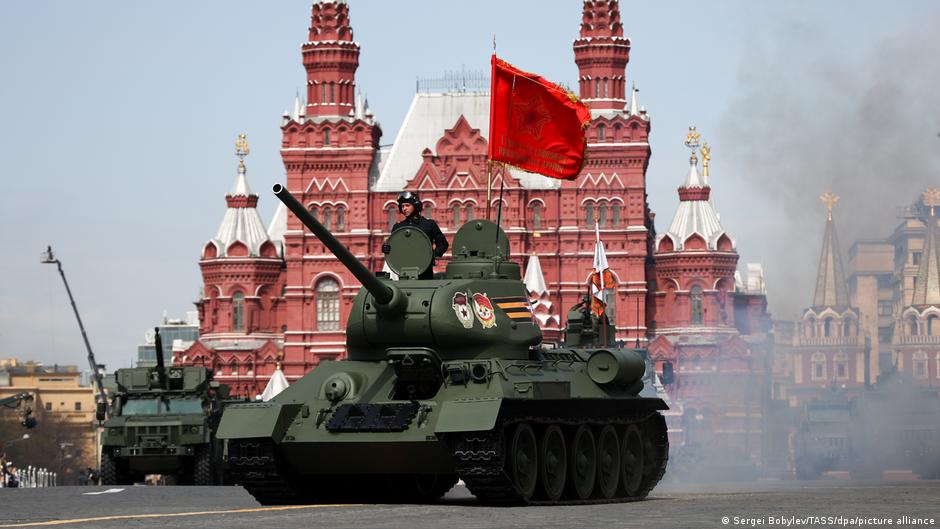
This year's May 9 military parades in Moscow will be much more modest and have been canceled altogether in other parts of Russia. The Kremlin has blamed Ukraine.
Russia's Ministry of Defense cited the "current operational situation" as the reason for the decision.
Russian President Vladimir Putin's press secretary, Dmitry Peskov, explained that no military hardware would be used in the celebrations because of the "terrorist threat" from Ukraine.
In some regions of Russia , the Victory Day celebrations have been canceled entirely. There will be no parades in Nizhny Novgorod, Saratov, Chuvashia and Kaluga, and no fireworks in Voronezh, Kursk, Bryansk and Belgorod.
St. Petersburg strips down to one tribune on Palace Square According to the Russian news site Fontanka , the celebrations in Russia's second-largest city St. Petersburg will also be more subdued than usual: "There won't even be a restored T-34 tank on display — in recent years, it was usually the first to be presented." And instead of the usual three tribunes, there will only be one on Palace Square, which will seat about 300 people. Veterans of the "Special Military Operation," as Russia's war in Ukraine is officially referred to, have been invited to attend.
Markus Reisner, a historian at the Theresian Military Academy in the Austrian city of Wiener Neustadt, told DW that recent Ukrainian drone attacks on the Russian city of Perm had shown that "Ukraine is practically capable of striking any target in western Russia." He added that the risk of a saturation attack was growing "despite a dense air defense network around Moscow ." He also pointed out that equipment and vehicles that might have been used in a parade were currently in use on the front, as well as the logistic support that would have been used to transport them.
He argued that this is why they would not be displayed, "not because of the terrorist threat Peskov has spoken of, but because the war is devouring all of the resources." Russia still had enough equipment, he said, "but the logistics required to haul it back and forth entail a disproportionate effort." Kremlin does not want to 'draw too much attention' According to military expert Jan Matveyev, the Russian armed forces do have enough military equipment, apart from air defense. "Tanks, armored vehicles, infantry fighting vehicles, and artillery are currently only being deployed on the front lines to a limited extent. It is entirely possible to make equipment available for the parade," he told DW.
He pointed out, however, that during Boris Yeltsin's presidency in the 1990s, the May 9 parade was not yet a regular event.
"In 1995 and 1996, attempts were made to appropriate the theme of the 'Great Patriotic War,'" he said, explaining that the government in this way sought "to win over the communist electorate and unite various social classes around it, including those that did not support Yeltsin." He said that later, great importance was placed on inviting foreign guests. In 2005, European leaders, US President George W. Bush and the Chinese president had attended. But over time, the significance of foreign guests dwindled, and now play a minor role.
"The commemoration of World War II and the Soviet Union's victory are a key instrument in the Kremlin's memory politics," political scientist Ivan Fomin told DW. "These narratives play a key role in underpinning the regime's legitimacy. Even the current war with Ukraine is often interpreted through parallels to that war." This explained the Kremlin's desire to "maintain familiar forms and rhythms of commemoration," he added.
Fomin does not believe that a scaled-back parade would significantly dent Putin's popularity or [people's] confidence in the government. "This could be yet another symptom of the state's inability to fully address current challenges and maintain normal life in wartime," he said, pointing out that there were already "internet blackouts, drone attacks and so on." He speculated that the parade could lose its significance for many Russians who had previously watched it for the military equipment on display, leading them to skip it this year and possibly in the future as well.
Fomin also thinks that Peskov's comments linking the reduced parade to the possibility of Ukrainian attacks could also have an impact on Russians.
On the one hand, he said, they suggested that the government was unable to guarantee safety in the capital. On the other hand, they could also further fuel anti-Ukrainian sentiment.
"People might perceive this as Ukraine disrupting their usual celebrations, as a loss of the opportunity to mark an important anniversary. Reactions will vary," said Fomin.
This article was originally written in Russian.
How NATO benefits from Ukraine's war experience To view this video please enable JavaScript, and consider upgrading to a web browser that supports HTML5 video Advertisement