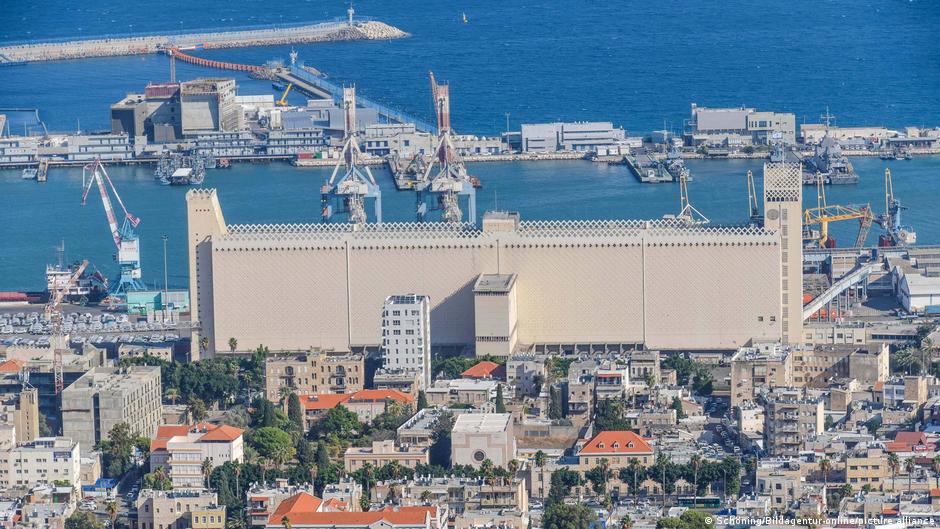
Cargo ships have docked in Haifa, Israel, carrying grain thought to originate from Russian-occupied parts of Ukraine. Kyiv considers the cargo to be stolen goods — but Israel says evidence is lacking.
On April 12, she reported that the Russian cargo ship Abinsk had arrived at an Israeli port, carrying stolen Ukrainian grain.
She said the Abinsk came to Haifa, in Israel, with a cargo of 43,765.18 tons of wheat from the occupied territories of Ukraine. There was no official confirmation of this information at the time of publication.
War of words between the foreign ministers Two weeks later, the Ukrainian Foreign Minister Andrii Sybiha said that another ship carrying grain stolen by Russia from Ukraine’s occupied territories had docked in Israel. As a result, the Israeli ambassador in Kyiv was summoned to the Foreign Ministry.
"You did not even submit a request for legal assistance before turning to the media and social networks," he said. "Diplomatic relations, especially between friendly nations, are not conducted on Twitter or in the media." For its part, the Ukrainian Ministry of Foreign Affairs released a timeline of the grain dispute. It said the issue was discussed by diplomats from both countries in late March, and on April 15, Ukraine requested international legal assistance from Israel regarding the ship called Abinsk.
Ukraine draws up a package of sanctions Ukrainian President Volodymyr Zelenskyy has also weighed in on the dispute.
"In any normal country, the purchase of stolen goods is a criminal offense that carries legal consequences. This applies in particular to grain that Russia has stolen," Zelenskyy wrote on Telegram on April 30.
He said that Russia is systematically removing grain from the occupied territories and exporting it. "Such trade violates Israeli law. Ukraine has taken all necessary diplomatic steps to prevent such incidents," Zelenskyy said.
He emphasized that Ukraine is working on a package of sanctions based on intelligence information. It would target everyone involved in transporting this grain, as well as people "seeking to profit from such criminal activities." According to Zelenskyy, Kyiv is coordinating its measures with European partners to ensure that the individuals in question are also placed on European sanctions lists.
Call for evidence Israeli military expert David Sharp speculates that the Israeli side would not have escalated the situation if it had received comprehensive evidence from Kyiv regarding the origin of the grain from the occupied territories.
"No one needs these problems — neither a deterioration in relations with Ukraine nor sanctions," Sharp told DW. The question is what evidence Ukraine actually presented and what the Israeli side actually received.
Sharp emphasizes that Israel is a country with an independent judiciary, where private business relationships are protected by law. The Foreign Ministry cannot order a businessman to terminate a grain purchase contract. Doing so would result in the government official being taken to court.
"Terminating a contract requires strong legal evidence, including intelligence evidence," Sharp explained. "If Ukraine wants Israel to block a deal, mere suspicions or social media posts aren’t enough. It must provide evidence that the Israeli government can use in court or present to the prosecutor’s office." Challenges in gathering evidence Ivan Us, chief consultant at the National Institute for Strategic Studies in Kyiv, explained that this is not the first time Russia has sought to legalize stolen Ukrainian grain in this way. The grain is transported from the occupied territories, mixed with Russian grain at transshipment depots, declared as Russian grain, and finally resold.
"From our perspective, it is stolen grain, but to the buyer, it may appear to be a legal product," said the foreign policy expert. This complicates the collection of evidence and thus the legal prosecution of these schemes.
According to Serhiy Danylov of the Ukrainian Association of Middle East Studies, the Ukrainian embassy provided the Israeli side with intelligence information regarding routes, shipments of the grain at sea, as well as the owners and logistics behind the shipments. He criticizes Israel for ignoring all Ukraine’s warnings.
"A request for legal assistance has already been submitted to the relevant Israeli authorities," Kravchenko said. He emphasized that Ukraine is asking its Israeli partners to detain the ship and its cargo, search it, secure the ship’s and cargo documents, take grain samples, and question the crew members.
According to Kravchenko, since the start of Russia’s full-scale invasion of Ukraine , more than 1.7 million tons of agricultural products with a total value of over 20 billion hryvnia (equivalent to approximately €388 million/$455 million) have been illegally exported from the temporarily occupied Ukrainian territories.
On April 30, the Interfax-Ukraine news agency reported, citing the Israeli newspaper The Marker, that the Israeli company Zenziper had ultimately refused to accept the shipment, which was likely stolen Ukrainian grain. The freighter had left Haifa.
"We have won; the cargo ship is leaving the port for neutral waters. We will see the criminal and sanctions proceedings through to the end," Ukraine's ambassador to Israel, Yevgen Korniychuk, told the news agency.
According to a report, the Russian supplier was informed of the order to refuse the ship's cargo. The grain import company Zenziper states that "the Russian supplier of the grain shipment must find another location for unloading." "This is the first time that a grain shipment, which is believed to have been stolen in Ukraine, has not been accepted and unloaded in Israel," Interfax-Ukraine quotes Israeli media as saying.
This article was originally written in Ukrainian.
Advertisement