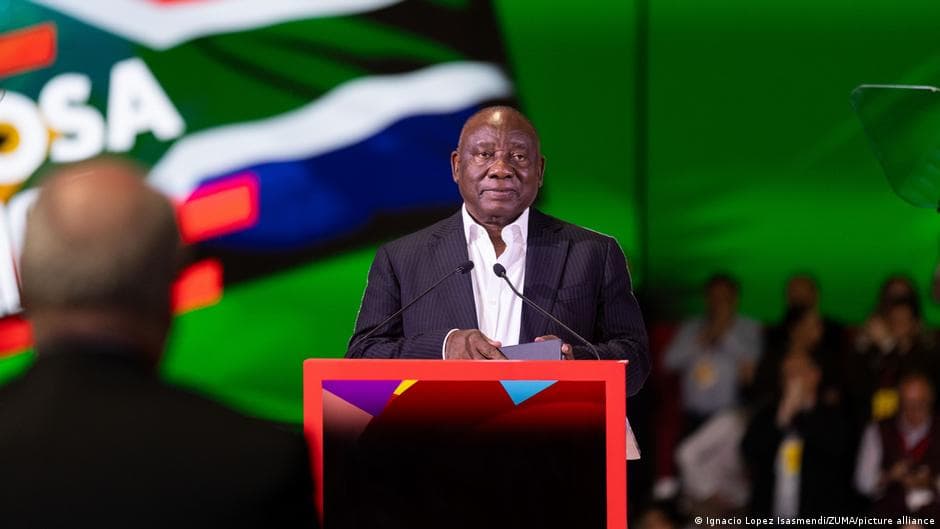
Ramaphosa sidestepped an impeachment inquiry in 2022 when his ANC-dominated parlimanent blocked it. Now that South Africa's top court revived it — can he escape through a parliament he shares with former adversaries?
But he announced on Monday that he will not resign and said he will challenge the impeachment proceedings against him.
"I therefore respectfully want to make it clear that I will not resign," Ramaphosa said in a televised address.
Ramaphosa's move came after Parliament signaled it will restart the impeachment process — and as public indignation over the so-called Phala Phala scandal appeared to intensify.
Many South Africans have hailed the May 8 Constitutional Court judgment that overturned the "No" vote by lawmakers in 2022 on whether an impeachment process should start. Others have called on Ramaphosa to step down.
Ramaphosa's standing in public opinion under pressure Three days after the Constitutional Court judgment, the Parliament announced that it would begin setting up a new Section 89 impeachment committee. Section 89 is the part of South Africa's Constitution that sets out how a president can be removed from office.
Commenting on the Constitutional Court ruling, Thelela Ngcetane-Vika, a governance expert at Wits University, told DW that Ramaphosa is guilty only in the court of public opinion. "... I think we must emphasize this: It is not a return on a verdict of guilty or innocence against the president." In his televised address, Ramaphosa signaled that he would seek a judicial review of the 2022 Section 89 panel report that found prima facie [Latin for "at first glance"] evidence that he may have violated the constitution or committed misconduct.
"He's acting in bad faith because in 2022 he misled his caucus, or politically maneuvered with the ANC caucus to say this report is legally flawed therefore he is going to take it on review," Vuyo Zungula, the ATM's parliamentary leader, told the public broadcaster SABC.
"After the ANC shut down that report, the Constitutional Court came and said he does not have direct access to challenge that report. From 2023 up until 2026, he never saw it fit to challenge that report." Zungula said the ATM had asked Ramaphosa in 2024 why he left a report that brought "a stain on his character" unchallenged. "For him to fight against being investigated, it shows the type of president he is." Can ANC MPs rescue Ramaphosa again?
In 2022, the ANC still held a majority in Parliament. When the scandal broke, the Democratic Alliance was the opposition parties that supported the ATM motion for an impeachment. But the ANC defeated it in a vote.
Ngcetane-Vika told DW that a vote to impeach the president in South Africa requires a two-thirds majority vote in Parliament. By comparison, a no-confidence vote would require a simple majority.
"It is before now, not only the parliament, but it is also, I suppose, before the ANC, the broader ANC, to consider the implication of this," Ngcetane-Vika told DW.
The ANC is known to be fragmented, with some party members not firmly in Ramaphosa camp since he took over from the party's ousted leader Jacob Zuma in 2018.
Where Ramaphosa's main coalition partner stands now But then, there's the changed political landscape following the first vote on an impeachment process in 2022. In a 2024 general election, the ANC lost its outright control of Parliament. The party was then forced to build a government of national unity with other parties, including the opposition Democratic Alliance (DA).
"So I don't want to over-speculate on how and who will vote for, but it's safe to say that in the public discourse we had the Democratic Alliance seem to be insinuating that they will not vote for him to be impeached." In a statement on May 12, the DA wrote: "This remains an ANC-made crisis, rooted in serious unanswered questions about the President's conduct and the ANC's long record of shielding its own leaders from accountability." It was Ramaphosa's legal right to challenge the Constitutional Court ruling, but he should do so without delay, the party said.
"President Ramaphosa should bring any review application with due haste and on an expedited basis, so that the legal position is clarified quickly and this matter is not delayed unnecessarily." The DA also urged Parliament to seek urgent legal counsel on the president's review, saying clarity was needed on the implications for the impeachment committee.
Background to the Phala Phala case — big cash, buffalo and arrests in Namibia The scandal centers on the alleged theft of a large sum of cash from Ramaphosa's Phala Phala Wildlife farm. It came to light in June 2022 when former spy chief Arthur Fraser went public with what he said was a theft of close on $4 million and an unlawful investigation.
The case triggered what beame a major political scandal. Ramaphosa admitted that he had $580,000 — the proceeds of the sale of buffalo to a Sudanese businessman — on the premises. Media reports, quoting from leaked documents, said security officials had coordinated unlawful arrests in Namibia.
In September of that year, Parliament set up an independent Section 89 panel tasked with determining whether Ramaphosa may have violated the constitution, seriously violated the law, or committed serious misconduct.
A day after the Constitutional Court ruling, Nosiviwe Mapisa-Nqakula, an ANC veteran and the speaker in Parliament at the time of the 2022 vote on impeachment, detailed the process in an interview.
"That process was meant for the president to ventilate. To take people through everything which happened. It was not meant to put him on trial," she said.
Several legal and political experts have pointed out that South Africa's Constitutional Court has reinforced the principle that no one is above the law.
Michael Oti and Thuso Khumalo in Johannesburg contributed reporting.
Edited by: Keith Walker Advertisement