Chancellor Friedrich Merz says Germany must buckle down to ensure economic renewal, amid geopolitical turmoil. Meanwhile, inflation is up again with energy prices a key driver pushing up costs. DW has the latest.
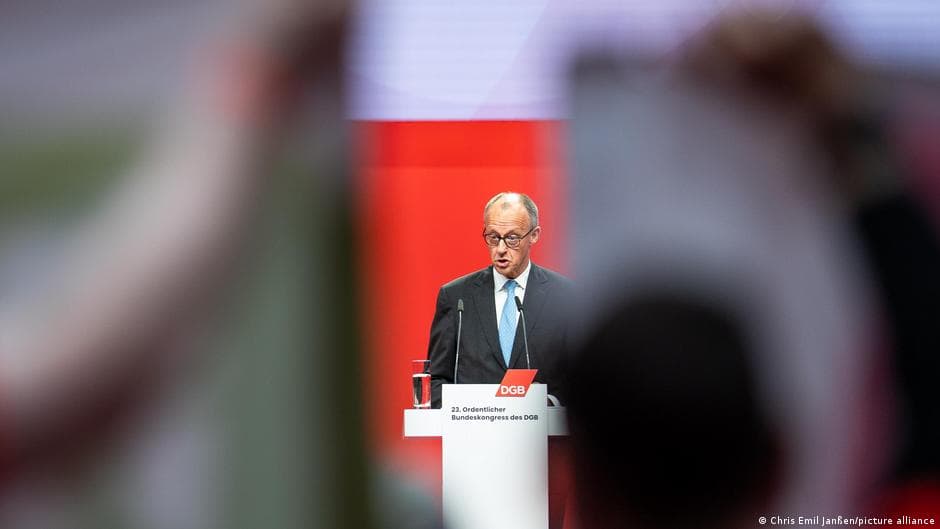
Skip next section Merz faces union boos over reform push 05/12/2026 May 12, 2026 Merz faces union boos over reform push Michaela Kuefner Berlin The chancellor took his reform message directly into the lion's den — the conference of the German Trade Union Confederation (DGB), writes DW’s Chief Political Editor Michaela Küffner.
And things unfolded exactly as expected: ranging from frosty to heated.
"Everyone will have to give something, and in return, we will gain a great deal"—this was a message no one here wanted to hear, let alone "share the burden" as the Chancellor had urged.
There were whistles, along with a few boos and shouts of "Tax the rich!" Merz remained composed, explaining — amidst the occasional murmuring — why Germany's prosperity urgently requires greater economic growth in the near future — growth which, in his view, necessarily entails a degree of sacrifice.
Merz refused to be provoked. He vowed to continue seeking compromise — even in the face of resistance — in order to tackle healthcare, pension, and tax reforms designed to remain effective "for a decade." DGB Chairwoman Yasmin Fahimi took the opportunity to remind the audience that the DGB had established its own pension commission after being denied access to the Federal Government's commission. It was a sore point.
The very evening before, at the unions' conference hotel, Social Democrat (SPD) Vice-Chairman Lars Klingbeil had already received a stern reminder that "the SPD emerged from the labor movement, not the other way around." The pressure on the SPD — the chancellor's coalition partner — to offer a counterproposal to Merz’s reform plans is intense.
Whether this deeply ingrained and carefully nurtured class animosity remains mere political theater — or even derails this government's reform agenda entirely — will be judged not by the noise it generates, but ultimately by the concrete results it yields. Proposals regarding pension reform are expected before the summer recess.
He told the German Trade Union Confederation in Berlin that pressure to act had not been this intense for decades, citing global upheaval and ingrained structural problems.
The chancellor said the pressure now had "likely not been as great for politics, society, and businesses for decades as it is at present." The world was realigning itself explosively and at breakneck speed, he said, adding: "Germany must therefore pull itself together." Merz said Germany’s economy has been stagnating for at least seven years while other countries continue to grow. Growth, he said, is essential for jobs, tax revenues, a functioning welfare state, and stable pensions.
The chancellor warned that Germany is losing more than 100,000 industrial jobs each year and said the country cannot continue on its current path.
He pointed to rising energy, production and living costs linked to the Iran war, along with heavy bureaucracy weighing on businesses. But Merz said the challenges were also homegrown, adding that Germany had failed to modernize in areas such as demographics and digitalization.
Merz's first year marked by coalition tensions, AfD gains To view this video please enable JavaScript, and consider upgrading to a web browser that supports HTML5 video https://p.dw.com/p/5Dcto Skip next section Welcome to our coverage 05/12/2026 May 12, 2026 Welcome to our coverage Richard Connor | Rana Taha Editor Guten Tag from the DW newsroom in Bonn.
You join us as Germany Chancellor Friedrich Merz says the country needs to get its act together after years of economic drift.
Merz told trade union leaders in Berlin that the pressure to act had not been this intense for decades, pointing to global shocks and long-standing structural issues at home.
Meanwhile, inflation in Europe's largest economy has risen once again.
Stick with us for these and other stories that Germany is talking about.