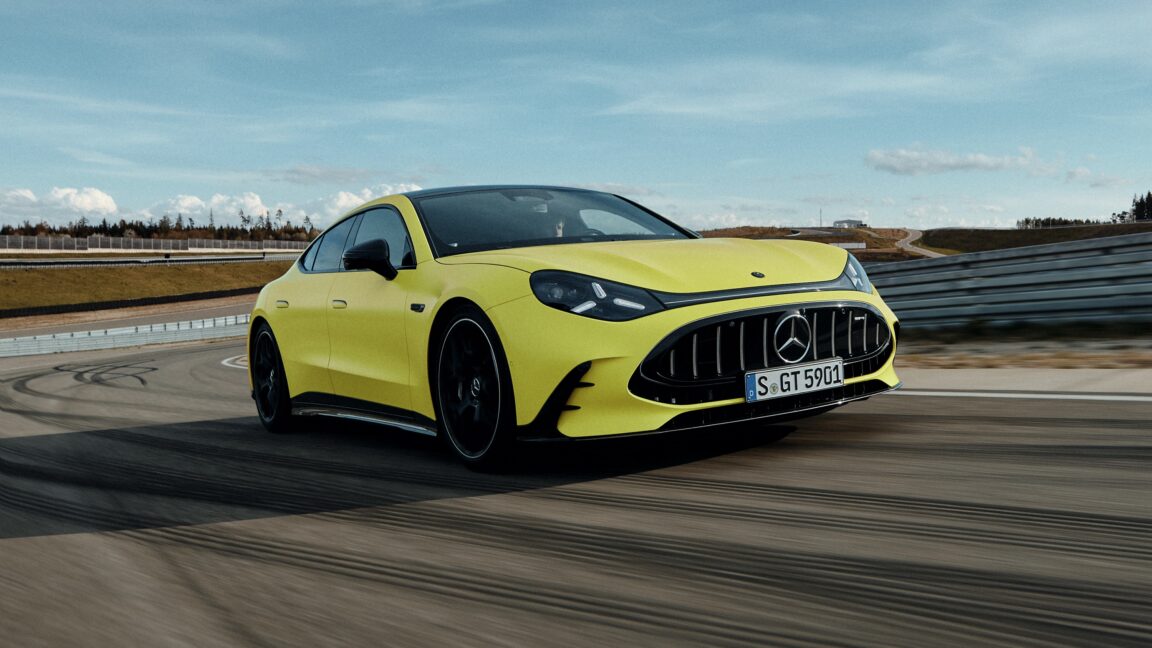
The 0–60 time is impressive, the miles/kWh number even more so.
Story text Size Small Standard Large Width * Standard Wide Links Standard Orange * Subscribers only Learn more At a star-studded event that closed downtown Los Angeles’ Sixth Street Viaduct last night, Mercedes and AMG unveiled the next generation of performance electric vehicles. The new four-door GT Coupe arrives in the midst of a pivotal period, the result of an almost experimental process that seems to take two steps forward and one step back quite regularly. In many ways, the all-electric AMG leaves previous plans in the past by effectively bringing the record-setting Concept AMG GT XX to series production, with many firsts for Mercedes supporting the abandonment of internal combustion power, including new axial motors from YASA and F1-derived battery cells.
Fittingly, then, Mercedes brought out its F1 team’s personnel, as George Russell presented the new car while Toto Wolff and Kimi Antonelli watched from the makeshift grandstands. Hollywood celebs ran the gamut, from Brad Pitt—who drove one GT onto the bridge—to Jacob Elordi and Kevin Hart, while Blink 182 played a surprisingly sarcastic mini set. All of the above may mean less to potential GT buyers than performance metrics and pricing when the 2027 model year comes along, but it only serves to prove just how big a deal Mercedes-AMG believes this will be.
The new AMG GT 4-Door brings to production a lot of technology we saw in the GT XX concept a few years ago.
Mercedes-AMG The new AMG GT 4-Door brings to production a lot of technology we saw in the GT XX concept a few years ago.
Mercedes-AMG Part sports car, part limo, the GT 63 4-Door is ridiculously quick.
Mercedes-AMG Part sports car, part limo, the GT 63 4-Door is ridiculously quick.
Mercedes-AMG The new AMG GT 4-Door brings to production a lot of technology we saw in the GT XX concept a few years ago.
Mercedes-AMG Part sports car, part limo, the GT 63 4-Door is ridiculously quick.
Mercedes-AMG A new look In person, the new GT bears almost no resemblance to any of Benz’s prior EVs. No more bulbous, nautical EQS shapes or minorly smoothed over boxy G-Wagen aesthetic . The new design is more aided by digital renderings and iterative algorithms, especially the jutting front grille, reclined headlights, and Kamm-tail rear end—a bit of Aston Martin fore and aft. From the profile view, the proportions fit somewhere between a Porsche Panamera or Taycan, low-slung and slippery for ideal aerodynamic efficiency.
Specs on paper support that impression, as the new GT measures 1.7 inches (43 mm) shorter in height and 1.4 inches (35.5 mm) longer overall, with the wheelbase stretched by 3.5 inches (89 mm) versus the outgoing model . Inside, the increasingly digital cockpit continues to evolve, with a new dash layout and canted touchscreens. The event afforded nobody but the stars a chance to actually sit in the passenger compartment, but diagrams shared with the media in advance revealed a typical EV skateboard chassis, albeit with a center spine similar to a transmission tunnel on an internal-combustion engine car to house critical EV components, as well as “foot garages” dropped in between battery modules that improve ergonomics. The large hatchback trunk behind the second-row seats complements a minuscule 1.4-cubic-foot (40L) frunk.
Axial flux motors The four-door hatchback will launch in two variants, as usual a 55 and a 63. Both share the same hardware, though the former restricts output to “just” 805 hp (592 kW) and 1,328 lb-ft (1,800 Nm) of torque, while the latter bumps up to 1,153 hp (848 kW) and 1,475 lb-ft (2,000 Nm). All that shove comes courtesy of Mercedes-Benz’s wholly owned subsidiary, YASA, which last year announced a new world record for the most power-dense electric motor ever built. YASA’s axial e-motors can be found in McLarens , Lamborghinis , and Ferrari hybrids and in this application promise a 67 percent reduction in both weight and physical length versus a more traditional radial-flux motor—with double the torque density and triple the power density, no less.
The GTs house two of the YASA motors at the rear, with dual water-cooled DC/AC converters and a planetary gearset to each side. Up front, a single motor mates to a spur-gear transmission with an integrated disconnect unit to allow for less drag while freewheeling. The motor sizes truly boggle comprehension, at just 3.5 inches (89 mm) wide for the front and 3.2 inches (81 mm) wide for each rear. YASA eventually believes that these units with a custom planetary gearset can effectively replace wheel hubs and brake rotors entirely, but apparently that solution wasn’t ready for mass-market production quite yet.
Mercedes-AMG Mercedes-AMG Mercedes-AMG Mercedes-AMG Mercedes-AMG Mercedes-AMG Mercedes-AMG Mercedes-AMG 600 kW charging The motors save space and mass, but Mercedes-AMG also put serious work into the battery tech. The load-bearing structure houses 106 kilowatt-hours of usable capacity, good enough for up to 474 miles (764 km) of range on the WLTP standard for the 63 or 478 miles (770 km) for the 55. A total of 2,660 new cylindrical cells each measures 4.1 inches (104 mm) tall and 1 inch (25 mm) in diameter, allowing for improved cooling by a non-conductive oil within 18 laser-welded plastic modules.
With 800 V architecture, the battery can charge at 800 A and up to more than 600 kW, which allows for a claimed 70 kWh or the equivalent of 287 miles (462 km) of WLTP range added in just 10 minutes. A 10–80 percent charge takes as little as 11 minutes, or a quick stopover can top up 41 kWh in just five minutes. Of course, here in the US that would require plugging in to something like ChargePoint’s new 600 kW fast charger, which will feature the necessary NACS plug required to recharge a North American-spec GT.
The slippery aero design also includes venturi flow elements built into the underbody, as well as an active rear diffuser and active front louvers to direct air into the large front fascia. A set of optional 21-inch aero wheels can contribute up to 8.7 miles (14 km) of range, and choosing the right tires can add another 18.6 miles (30 km). In the ideal configuration, the GT’s drag coefficient is an impressively low 0.22—which contributes to the 4.5 miles/kWh (13.8 kWh/100km), or just shy of a Lucid Air Pure ’s 5.0 mi/kWh (12.4 kWh/100 km) despite well more than double the Lucid’s power output.
Credit: Mercedes-AMG Credit: Mercedes-AMG However, all that battery pack does add up to a curb weight around 5,400 pounds (2,460 kg). Straightline acceleration will not be a problem, given the output of YASA’s motors, and Mercedes claims a 0–60 mph time of just 2.0 seconds, a 0–124 mph (0-200 km/h) of 6.4 seconds, and when equipped with the optional AMG Performance Package, a 186 mph (300 km/h) limited top speed. At that high end, the axial motors spin at 15,000 and 13,000 rpm for the front and rear, respectively. And the powertrain hasn’t even reached full bore yet, apparently—a future variant will likely eclipse 1,300 hp (956 kW) and even more range.
Make it loud?
Still, the GT needs to live up to luxurious highway cruising as well, now a legit possibility given the range and charging capabilities. Two air suspension setups include Active Ride Control standard on the 63, which uses a 2.1-gallon (8.2L) pressure reservoir for speed-dependent ride height adjustment, along with a fully linked hydraulic roll control system. Previous heavy AMGs handled quite well, so presumably the fully electric GT will live up to the nameplate. Whether the silly AMGFORCE Sport+ fake V8 sounds, including haptic seat exciters and simulated gearshifts (which can all switch off, thankfully), will accentuate the driving experience remains a question that only true seat time will play out. Amid the booming speakers and crowd noise, the faux engine noises barely registered.
Of course, it’s hard to escape the irony of setting off a massive pyrotechnic display—not to mention flying radiant influencers in from all across the globe—while promoting the next step toward supposedly cleaner performance. And Mercedes declined to confirm whether a gasoline or hybrid GT four-door will join the lineup, other than to promise that a Euro 7 inline-six and a new V8 are in development. Regardless, will AMG buyers want to live without the wonderful wellspring of V8 torque at the heart of prior models? In comparison to other top-spec EVs, including the Lucid Air Sapphire, Tesla Plaids, Porsche Taycan Turbo GT, and Audi RS e-tron GT, presumably the new GT will wind up pricing somewhere in the middle of the pack, or well into six figures.
There’s plenty of carbon fiber for the interior.
Mercedes-AMG There’s plenty of carbon fiber for the interior.
Mercedes-AMG The back seat is strictly for two.
Mercedes-AMG The back seat is strictly for two.
Mercedes-AMG There’s plenty of carbon fiber for the interior.
Mercedes-AMG The back seat is strictly for two.
Mercedes-AMG The rear cargo hatch is pretty spacious.
Mercedes-AMG The rear cargo hatch is pretty spacious.
Mercedes-AMG The frunk is good for keeping a charger adapter.
Mercedes-AMG The frunk is good for keeping a charger adapter.
Mercedes-AMG The rear cargo hatch is pretty spacious.
Mercedes-AMG The frunk is good for keeping a charger adapter.
Mercedes-AMG Moving more GT units may matter less than the perceived halo effect or trickle-down appeal for the entry-level electric CLA for example, which starts at a surprisingly attainable price point below $50,000. Which perhaps explains why in similar fashion to the CLA, the GT drops all nomenclature specifically signifying the electric powertrain—no more “EQ” or “with EQ Technology” or “AMG E-Performance” badging. In short, it would appear that for Mercedes and AMG, the time has finally come that cars are just cars, regardless of the means of propulsion.
14 Comments