It could be one way to make your old PC play nicely with a high-end GPU.
Story text Size Small Standard Large Width * Standard Wide Links Standard Orange * Subscribers only Learn more It’s not an ideal time to be buying a new PC or doing a major upgrade. Price crunches for RAM and storage chips are making all kinds of components more expensive, and the shift to DDR5 in modern Intel and AMD CPUs means that a lot of people would need to pay money to replace their current DDR4 kits if they wanted to step up to a significantly newer, faster CPU and motherboard.
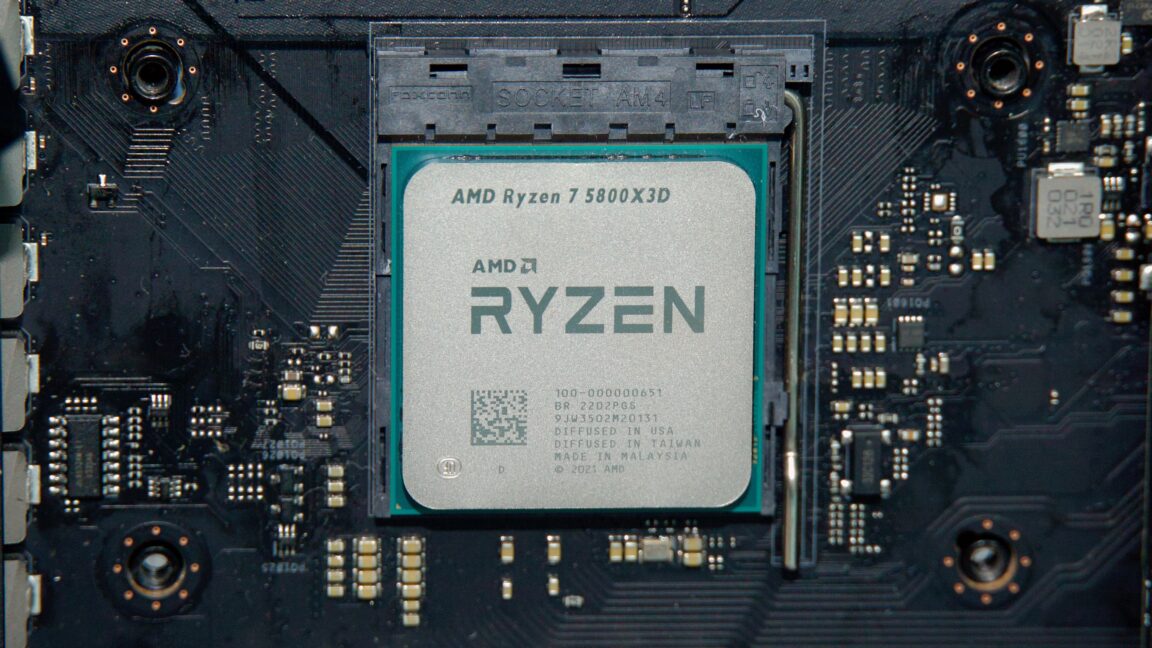
AMD may have something on the horizon for people who are looking to stretch their current PC (and its DDR4 RAM kit) just a little further. Leaks spotted by Tom’s Hardware point to the existence of an “AMD Ryzen 7 5800X3D 10th Anniversary Edition,” a re-release of a 4-year-old out-of-circulation CPU that might nevertheless be an upgrade for people with older Ryzen CPUs in Socket AM4 motherboards.
The “X3D” in the chip’s name signifies that it comes with 64MB of extra L3 cache stacked on top of the main CPU die, bringing the total amount of L3 cache to 96MB. Workloads that benefit from extra cache—including most games—will perform much better on the 5800X3D than they do on the vanilla Ryzen 7 5800X.
The “10th Anniversary” being celebrated isn’t for the 5800X3D itself, but the AM4 processor socket, which first launched back in September of 2016. The socket was succeeded by AM5 nearly four years ago , but AMD kept the AM4 socket around to continue to address the budget market. Higher prices for DDR5 RAM kits and AM5 motherboards themselves have helped keep the AM4 socket around since then, and while AMD hasn’t released any new architectures for AM4 boards since late 2020, it has been remarkably persistent in releasing and re-releasing remixed Ryzen 5000-series CPUs for the socket.
The 5800X3D was the first of AMD’s X3D releases, and it comes with the most compromises compared to standard Ryzen chips. It doesn’t support most forms of overclocking, and its base and boosted clock speeds are each a few hundred MHz lower than the regular Ryzen 5800X. If you’re not planning to pair the chip with a fairly fast, recent GPU from Nvidia’s GeForce RTX 40- or 50-series or AMD’s Radeon 9070 XT, a regular eight-core Ryzen 7 chip from the 5700 or 5800 series may get you better value for your money.
But for people with a high-end GPU who don’t want to pay today’s inflated prices for a good kit of DDR5 memory, a re-release of the 5800X3D could help stretch that old Socket AM4 system for just a few more years.
AMD hasn’t officially announced pricing or availability for this chip yet, but the apparent existence of retail packaging suggests its launch may be imminent. An Indian retailer listed the chip for about $310, though we’d take this with a grain of salt given ongoing disruption from tariffs, fuel costs, chip shortages, and other factors. Used versions of the 5800X3D start somewhere between $450 and $500 on eBay as of this writing, so anything lower than that would be a relative bargain, provided AMD can keep the chip stocked.
Andrew Cunningham Senior Technology Reporter Andrew Cunningham Senior Technology Reporter Andrew is a Senior Technology Reporter at Ars Technica, with a focus on consumer tech including computer hardware and in-depth reviews of operating systems like Windows and macOS. Andrew lives in Philadelphia and co-hosts a weekly book podcast called Overdue .
6 Comments