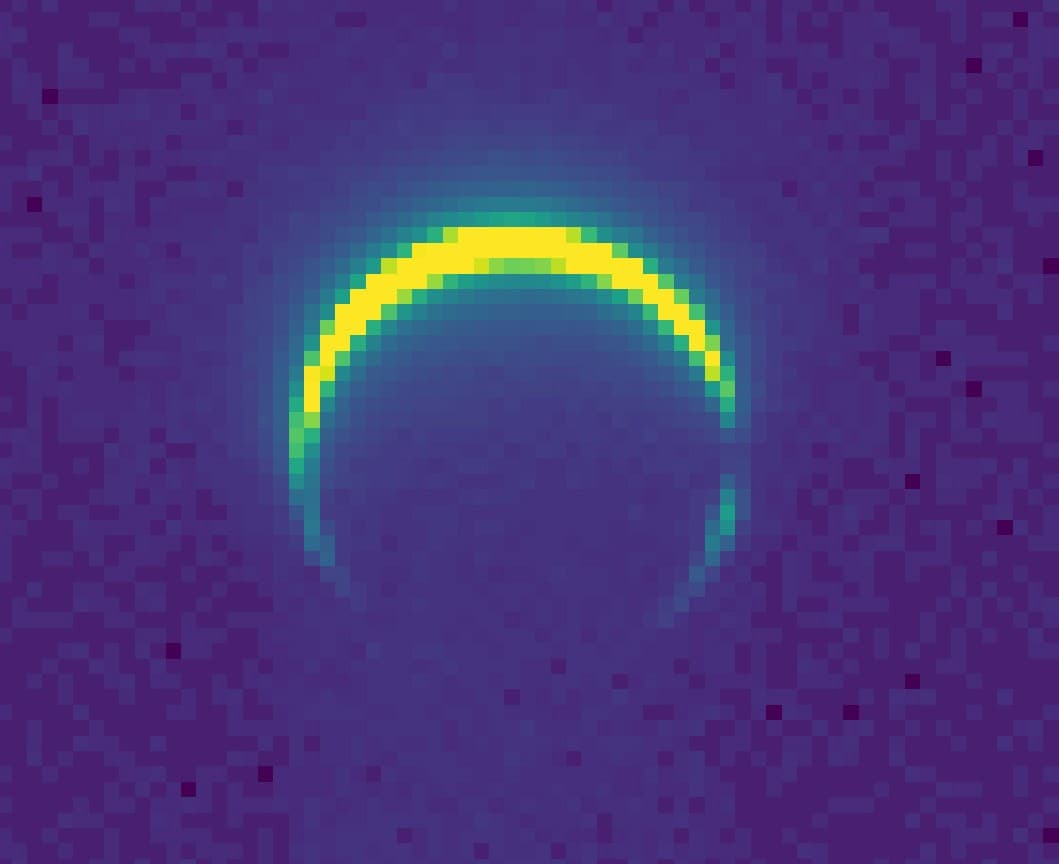
Description This colorized image of Mars was captured by NASA’s Psyche mission on May 3, 2026, about 3 million miles (4.8 million kilometers) from the planet. The spacecraft is approaching the planet for a gravity assist on May 15 that will give it a boost in speed and adjust its trajectory toward asteroid Psyche for […]
Photojournal Navigation 2 Min Read NASA’s Psyche Mission Captures Mars During Gravity Assist Approach PIA26750 Credits: NASA/JPL-Caltech/ASU Image Addition Date: 05/08/2026 Downloads NASA’s Psyche Mission Captures Mars During Gravity Assist Approach JPEG (132.38 KB) PIA26750 Figure A JPEG (105.92 KB) Description This colorized image of Mars was captured by NASA’s Psyche mission on May 3, 2026, about 3 million miles (4.8 million kilometers) from the planet. The spacecraft is approaching the planet for a gravity assist on May 15 that will give it a boost in speed and adjust its trajectory toward asteroid Psyche for eventual arrival in 2029.
The spacecraft is approaching Mars from a high-phase angle, meaning that the planet appears only as a thin crescent, like our own crescent Moon seen around its new Moon phase. From this viewing geometry, the Sun is out of frame and “above” both Mars and Psyche.
Figure A Figure A is a zoomed-out view from the imager. No stars are visible in the background since they are much dimmer than the sunlight being reflected by Mars.
The observation was acquired by the multispectral imager instrument’s panchromatic or broadband filter, with an exposure time of just 2 milliseconds. Even with this very short exposure time, the crescent is extremely bright and parts of the image are oversaturated. The light seen here is sunlight reflected off the surface of Mars and also scattered by dust particles in its atmosphere. Because the quantity of dust in the atmosphere can vary rapidly over time, the anticipated brightness of the crescent was hard to predict before this early image was acquired.
The dustiness of Mars leads to sunlight being scattered by its atmosphere, making the crescent appear to extend farther around the planet than if it had no atmosphere (as with our Moon).Of note, on the right side of the extended crescent, there appears to be a gap, which coincides with the planet’s icy north polar cap. The cap is currently in winter and mission specialists hypothesize that seasonal clouds and hazes may be forming in that region, possibly blocking the atmospheric dust’s ability to scatter sunlight like it does elsewhere around the planet.
The Psyche mission’s imager team will be acquiring, processing, and interpreting similar images in the lead-up to the close approach on May 15. The images are primarily designed to calibrate the cameras and to characterize their performance in flight as a practice run for the approach to asteroid Psyche in 2029.
For more information about the Psyche mission, read: https://science.nasa.gov/mission/psyche/ Keep Exploring Discover More Topics From Photojournal Photojournal Search Photojournal Photojournal’s Latest Content Feedback