
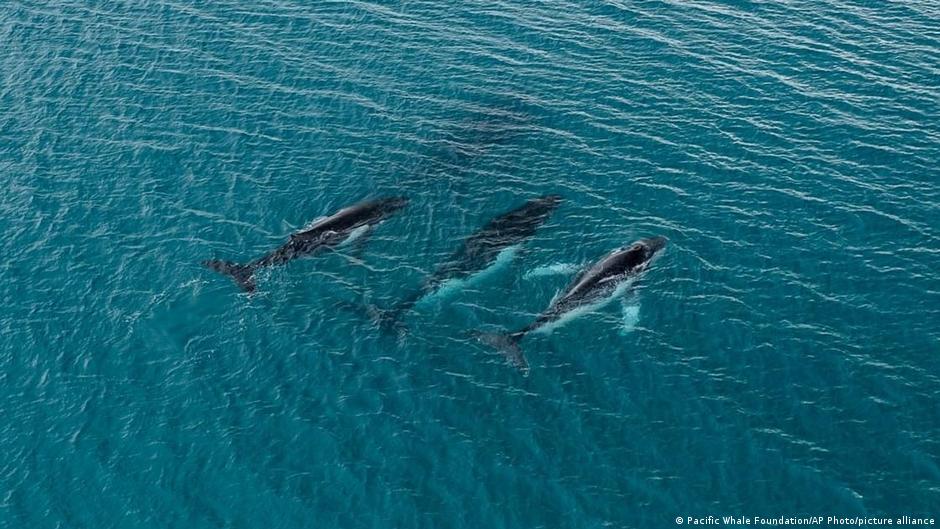
Researchers have observed two humpback whales swimming between Australia and Brazil. It's the longest travel distance humans have ever recorded for the species.
An article published in the Royal Society Open Science journal on Wednesday is the upshot of using tens of thousands of images of the sea-dwelling mammals' unique tails (or flukes) to identify the creatures and their movement habits.
One whale was spotted in Queensland, off Australia 's eastern coast, in 2007 and then again in 2013. It subsequently appeared near Sao Paulo, Brazil , in 2019 — two points separated by roughly 14,200 kilometers (8,823 miles).
The other whale was first observed off the coast of Bahia in Brazil in 2003, and then 22 years later off Hervey Bay in Queensland, 15,100 kilometers away.
The whales feed on krill and small fish in colder waters during the warmer summer months, and then move to more clement tropical waters — like those off Brazil and Australia — to breed during the winters.
"Resighting intervals of 6 and 22 years suggest that these are rare, possibly single-lifetime events rather than regular migratory shifts," the authors wrote.
Whale 'Timmy' found dead near Danish island To view this video please enable JavaScript, and consider upgrading to a web browser that supports HTML5 video Preliminary data suggests such journeys are very rare Of the thousands of identified whales studied, only 0.01% of the sample was found to have completed such a journey. But researchers called for continued global collaboration on photo-ID platforms to try to get a better sense of how common it might be.
"Despite their rarity, these exchanges matter for the long-term health of whale populations," Griffith University PhD researcher and report co-author Stephanie Stack said.
"Occasional individuals moving between distant breeding grounds can help maintain genetic diversity across populations," she said, adding that they also might bring new songs to new pods in the process.
Scientists suspect that climate change and warming oceans could make this phenomenon more common.
"Climate-driven changes to the Southern Ocean, including shifts in sea ice and the distribution of Antarctic krill, may be making such crossings more likely over time," Griffith University wrote.
Dr. Cristina Castro of the Pacific Whale Foundation thanked amateur whale spotters for their photographs that served as the database for study and allowed the movements to be identified.
“This kind of research highlights the value of citizen science," she said. "Every photo contributes to our understanding of whale biology and, in this case, helped uncover one of the most extreme movements ever recorded." Edited by: Sean Sinico