
Civ 7’s devs talk walking back the game's most controversial decision.
Story text Size Small Standard Large Width * Standard Wide Links Standard Orange * Subscribers only Learn more “Build a civilization to stand the test of time.” That was the promise on the box of Sid Meier’s Civilization , the first in a long-running strategy game franchise that has evolved over 35 years and seven mainline entries.
Civ 7 introduced a new approach to play wherein players would change civilizations from their initial selection twice by the end of a game. Lots of players said, “Wait a minute: we’re literally not building a civilization to stand the test of time anymore.” After such a negative reception at launch, longtime series fans began to wonder whether the franchise would continue to stand the test of time.
It’s clearly not a coincidence that the new, major update for the game reaching players today is titled “Test of Time.” It’s a major reworking of several of the game’s key systems, and it reintroduces the ability to play one civ from beginning to end while retaining some of the big ideas that defined Civ 7 at launch.
I’ve spent the past week playing the game with the Test of Time update, and I spoke with two of the game’s senior developers—the franchise’s creative director, Ed Beach, and series head of product Matt Schembari—about the choices they made, reacting to player feedback, and competing ideas about what Civ is to players.
A quick note on ages For those who haven’t been following Civ 7 up to this point: Another major change to the game is that it has been broken into three distinct ages: Antiquity, Exploration, and Modern. Each has its own tech and culture tree, game mechanics, and, until now, civilizations to pick from.
The intent behind it was to allow the game’s designers to solve some longtime problems with how traditional Civ games could lag or have balance problems at specific stages. If that in itself is too much deviation from the classic formula for you, it’s unlikely Test of Time will make you like Civ 7 any more than you might have a year ago. It’s still a foundational framework for this game. Test of Time gives players a lot more freedom inside that structure, but it does not remove the structure itself.
Give the people what they want Starting a new game of Civ 7 with the patch, the biggest change was immediately apparent. As of the last update before this one, you could pick from just 14 civs when starting a game in the Antiquity Age. This time, I saw more than 40.
I could play as America from the Age of Antiquity now, for example. When I set up the game, I was also given the option to choose the AI’s civ-switching behavior; I could prohibit it, allow it, or pick an option that makes the AI follow suit on whatever choice I make.
Yep, we have modern age civs as options for a game starting in antiquity.
Credit: Samuel Axon Yep, we have modern age civs as options for a game starting in antiquity.
Credit: Samuel Axon Of course, playing one civ throughout the three ages would seem to run counter to how the game was originally designed. Firaxis took this update as an opportunity to take a major game balance pass across all the civs, and it introduced some new concepts to make one civ for three ages fit the Civ 7 framework.
Civs are considered to have an “apex age,” during which they have access to their full kit. When they’re in an age other than their apex age, they’re called “time-tested civs,” and they have access to a limited amount of their normal bonuses. But players can use a system called syncretism to adopt bonuses that are normally offered to specific civs that would call the current age their apex age.
Based on playing one full game in the new patch, I feel this implementation works really well overall, and it’s a lot of fun.
That said, I could see it getting unwieldy to build on over time—the game’s designers now must account for many more possibilities and balance them against each other to make sure the game stays fair and fun.
When I asked Beach about this, he suggested it’s not as big a design challenge as it might seem. “I think we still have some advantages because of the structure of the game,” he said. “I think where we are giving ourselves an immense challenge is the content space, because we have 43 civs that you can play as, and now we need to give them bonuses in three different ages. So we went from basically 43 chunks of content that we need to balance to like 129 chunks of content, and as we add more civs it’s just gonna keep going further and further.
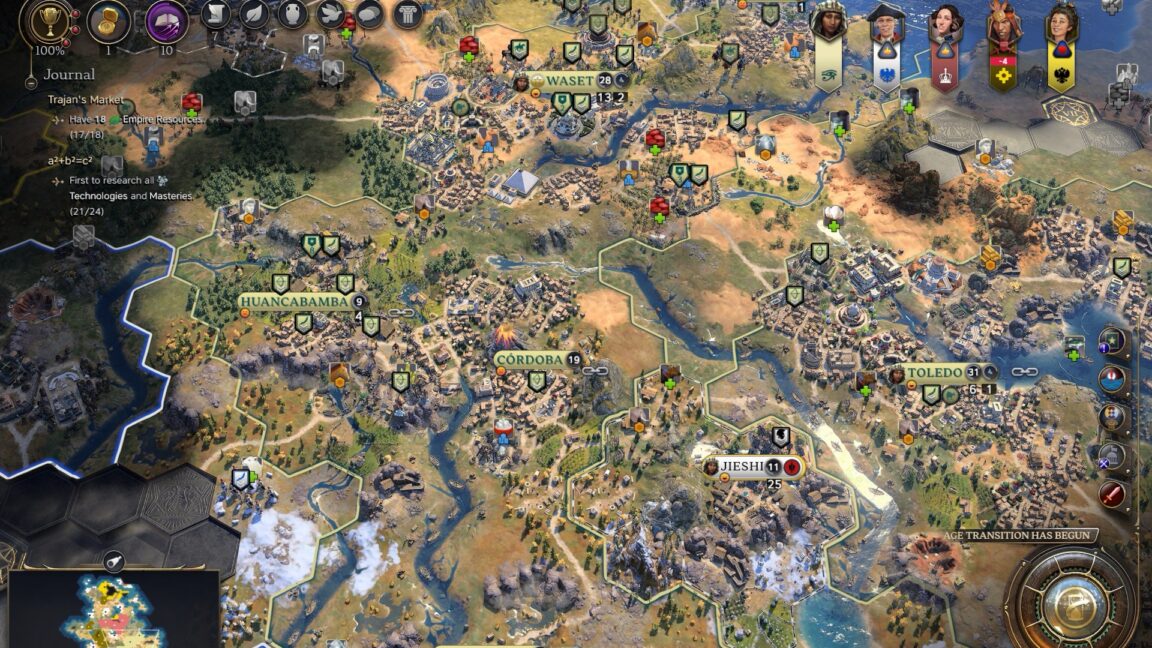
“We actually had a designer go through and write up a document for, ‘what is the core identity of each civilization and what should really be embodied by their unique ability and be what you see sort of foremost in how you play them during their Apex Age,’” he explained. “And then what we do is, we sort of disperse that out into the other adjacent ages and sort of make them echoes of the primary ability. And so that kind of gives us a—it’s not like it’s 129 totally unique pieces of content. It’s more like 43 different flavors of civilizations, and we have to provide three different power levels of each one.” I played a full game as Egypt and tested out the syncretism system. Test of Time gives players who wanted a single-civ experience what they want without breaking the principles of the base game. In fact, there’s even a hint of pre- Civ 7 here, in that the civs definitely feel most powerful during their apex age. (In older Civ games, many civs peaked in relative power at a certain point in a long game.) You’re given the option at age transition to stay with the same civ or change. Also, age transitions happen without fully booting you out of the main game view, which is a nice change.
Credit: Samuel Axon You’re given the option at age transition to stay with the same civ or change. Also, age transitions happen without fully booting you out of the main game view, which is a nice change.
Credit: Samuel Axon I think it’s the most successful part of the Test of Time patch, so if the lack of “one civ for the whole game” is the entire reason you’ve stayed away from Civ 7 , this is the time to jump in and see if it works for you after all.
“There are a lot of people on the design team that came forward with, ‘Hey, I think we’ve got a way that we can make everybody happy,’” Beach told me. “We can fit it into the existing framework, but also give players exactly what they’re looking for.” Triumphs and tribulations Full disclosure: My primary complaint with Civ 7 , after playing it for months on end, was not the civ-switching mechanic. For me, it was legacy paths, linear sequences of tasks that you had to perform to gain bonuses to set you up for the next age, and ultimately, to win the game in the modern age.
They added structure to a game that, for many players, is more of a sandbox than a linear series of challenges. Further, because they were the same every time you played, and there were only a few of them, they became tedious after multiple playthroughs.
The replacement here is triumphs, a large array of small objectives that you can complete within an age to gain bonuses.
The number of triumphs you’re presented with is honestly kind of overwhelming, but you’re likely to learn them as you go.
Credit: Samuel Axon The number of triumphs you’re presented with is honestly kind of overwhelming, but you’re likely to learn them as you go.
Credit: Samuel Axon Based on my play time, triumphs seem to be an improvement over the old legacy path system, simply by virtue of the fact that they avoid some of the monotony of following the same path over and over again. That said, many of them are just basic things that happen almost accidentally during a normal game, so not all of them are interesting strategic goals.
There are also triumph sets, which are unfortunately buried in the advanced game settings right now. These are packages of a limited number of triumphs that apply to the game you’re about to play. Picking one triumph set over another completely changes what you’re focused on in the game, and there’s a lot of potential for creatively designing triumph sets to make for interesting challenges.
I told Beach that I liked this feature. He said: We want to gauge everyone’s reaction to it, but we hope it’s the same as yours, because then I can see new triumph sets coming out the same time we put out like new map types as just more ways to play the game. We have some cool ideas also for things players could do with triumph sets, like it’s been suggested maybe you should have a triumph set where it picks from.
When I mentioned they seemed buried, he agreed: “I do think they need to be pulled out of the advanced settings and made something that you think about every time you set up a game.” For an option with such potentially huge ramifications for long-term civ play, it’s a bit weird that triumph sets are so buried in the menu.
Credit: Samuel Axon For an option with such potentially huge ramifications for long-term civ play, it’s a bit weird that triumph sets are so buried in the menu.
Credit: Samuel Axon The triumph sets are also moddable, so anyone with the ability to work with XML and with some knowledge of how the game’s library works should be able to make and release mod packs.
It’s early days with this feature, and I still think some ironing out is needed, but in theory, it seems like a great way to keep shaking up the game over time in future patches, just like adding new leaders or map types does.
Different test, different time Earlier this year, I spoke with Dennis Shirk, the executive producer for the Civilization series. I pointed out that while players have reacted strongly to big changes to the formula in the past (I used the one-unit-one-tile shift in Civ 5 as an example), this time feels different.
“It’s not all about the mechanics,” he said. “It’s about the game that players want to build for themselves.” In my view, the Civilization series is rooted in an earlier era of PC games when many titles were toy boxes. Rough edges were tolerated because they gave the player the ability to express themselves or feel ownership of their story.
By contrast, the years since then saw game designers formalizing language around the craft, focusing on sanding off rough edges, and holding the player’s hand to make sure no player had a bad experience because of an edge case.
Civ 7 saw that value system applied to this old franchise.
I didn’t talk about it much here, but the patch also overhauls victory conditions and lets you win as early as during the exploration age.
Credit: Samuel Axon I didn’t talk about it much here, but the patch also overhauls victory conditions and lets you win as early as during the exploration age.
Credit: Samuel Axon Civ 7’ s biggest changes were meant to solve old pain points and pacing problems that had existed since the dawn of the series, but solving them meant undermining some of the self-expression and freedom players had in earlier entries.
“I think that what you’re getting at is, where is there agency?” said Schembari, the series’ head of product, when I shared these thoughts. “With Test of Time, we opened up the game space so much more in terms of how the victories work and what you can do with civ switching and things like syncretism and all that. It now creates so many different elements for storytelling, for those narrative hooks for players to hang onto that… [it] creates a lot more of that role-playing possibility as well, that I think especially speaks to those gamers who came from that more, sandbox kind of era.” Beach acknowledged that the players from the early, sandbox-first-design era of the franchise “are the ones that are having the bigger problem adapting to Civ 6 and Civ 7 ,” and noted that the team has seen that players who are new to the series have had fewer qualms about the direction it’s going.
“I think if you look at from Civ 4 to Civ 5 to Civ 6 to Civ 7 , in each iteration as we’ve gone further in, we’ve sort of deepened the cultural representation of what a civ is, how many bonuses they have, how true to the period of history they are,” he told me. “We’re really trying to help the players tell the story and trying to give them historical hooks that they can latch onto in their heads to help them understand what’s going on in the game world.” By contrast, “back, 20, 25 years ago, that wasn’t there, but players just invented the stories in their head,” he said.
To try to bring some player voices into the mix alongside the designers, Firaxis hosted a series of community workshops to test the new update. “Once the workshop began, that created a really cool dynamic where the devs and the players in the workshop were directly speaking with each other in Discord, jamming in the channels, responding to specific feedback threads,” said Schembari.
Beach said the success of the new workshop program made him realize how much the team had been missing that. “You see a lot of negativity online these days, and it’s hard to avoid that,” he said. “But I have had lots of periods during my career where I have worked with fans as closely as we did during a workshop, and I think we’ve just gotten away from that for too long.” When asked how the team at Firaxis has weathered the intense player feedback over the past year, Beach went on to say, “To be brutally honest, there were a couple times during the, say, three, four months after launch, where I had to make a few morale checks. But overall, once you really start digging in, I think what’s really cool is we were able to give people exactly the experience they were expecting, but without breaking the structure of the game.” Some people value the original experience over fixing design problems that have affected the series for decades. It’s easier to accept flaws that you’ve gotten accustomed to than to embrace completely new ones.
I do still wish Civ 7 were a little more sandbox-y, a bit more emergent. It’s not my favorite in the series, but I think it’s getting increasingly indefensible to call it a “bad game.” Will Civ 7 be a civilization game that stands the test of time? I’m still not sure, to be frank. This update is a step in the right direction, though, and by giving players the ability to build a single civ that stands the test of time, it might finally meet more players’ definition of a good Civilization game.
Samuel Axon Senior Editor Samuel Axon Senior Editor Samuel Axon is the editorial lead for tech and gaming coverage at Ars Technica. He covers AI, software development, gaming, entertainment, and mixed reality. He has been writing about gaming and technology for nearly two decades at Engadget, PC World, Mashable, Vice, Polygon, Wired, and others. He previously ran a marketing and PR agency in the gaming industry, led editorial for the TV network CBS, and worked on social media marketing strategy for Samsung Mobile at the creative agency SPCSHP. He also is an independent software and game developer for iOS, Windows, and other platforms, and he is a graduate of DePaul University, where he studied interactive media and software development.
10 Comments